- Reference
- Fragm. (Mueller) 6:229 (1868)
- Conservation Code
- Not threatened
- Naturalised Status
- Native to Western Australia
- Name Status
- Current
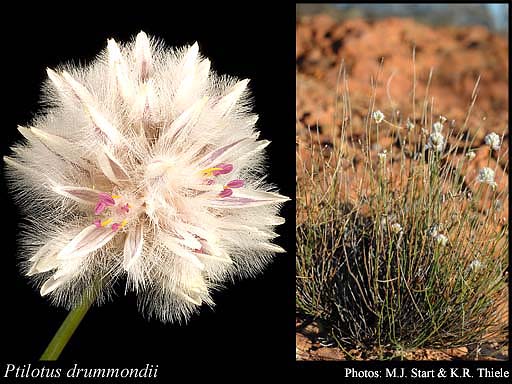
Perennial, herb, 0.05-0.8 m high. Fl. white-cream-pink, Mar or May or Jul to Dec. Sand, clay, loam, gravel. Low ridges, undulating plains, river slopes.
Scientific Description
Shrubs or perennial herbs, stems several, more or less prostrate or more or less erect, glabrescent or glabrous, with nodose hairs. Leaves present, 8-35 mm long, 1-4(-5) mm wide, glabrescent or glabrous, with nodose hairs; basal rosette present; cauline leaves alternate. Spikes pink, ovoid, solitary, with densely arranged flowers. Bracts (4.3-)4.6-5.5(-6.5) mm long, coloured or colourless, glabrous, awned or mucronate, with a prominent midrib. Bracteoles (3.5-)4-5(-6.5) mm long, colourless, glabrous, awned or mucronate, with a prominent midrib. Outer tepals 8-9.6(-13) mm long, entire or not entire. Inner tepals 7.6-9.1(-12.5) mm long, with a basal tuft of hairs on inner face. Style (1.7-)2-2.7 mm long, straight, centrally fixed to ovary. Distribution: South West, Northern and Eremaean Botanical Region; IBRA regions: Ord Victoria Plains.
Distribution
- IBRA Regions
- Avon Wheatbelt, Carnarvon, Central Ranges, Coolgardie, Esperance Plains, Gascoyne, Geraldton Sandplains, Gibson Desert, Great Sandy Desert, Great Victoria Desert, Jarrah Forest, Little Sandy Desert, Mallee, Murchison, Nullarbor, Pilbara, Swan Coastal Plain, Warren, Yalgoo.
- IBRA Subregions
- Ashburton, Augustus, Dandaragan Plateau, Eastern Goldfield, Eastern Mallee, Eastern Murchison, Edel, Fitzgerald, Fortescue, Geraldton Hills, Hamersley, Katanning, Lateritic Plain, Lesueur Sandplain, Mackay, Mann-Musgrave Block, Mardabilla, McLarty, Merredin, Northern Jarrah Forest, Nullarbor Plain, Perth, Recherche, Roebourne, Rudall, Shield, Southern Cross, Southern Jarrah Forest, Tallering, Trainor, Warren, Western Mallee, Western Murchison, Wooramel.
- IMCRA Regions
- Central West Coast, Leeuwin-Naturaliste.
- Local Government Areas (LGAs)
- Armadale, Ashburton, Augusta Margaret River, Beverley, Boddington, Boyup Brook, Bridgetown-Greenbushes, Busselton, Cambridge, Carnamah, Carnarvon, Chapman Valley, Chittering, Cockburn, Coolgardie, Coorow, Cottesloe, Cranbrook, Cue, Dalwallinu, Dandaragan, Dardanup, Dundas, East Pilbara, Esperance, Fremantle, Gingin, Gnowangerup, Goomalling, Greater Geraldton, Halls Creek, Jerramungup, Kalamunda, Kalgoorlie-Boulder, Karratha, Kellerberrin, Kent, Koorda, Kulin, Kwinana, Lake Grace, Laverton, Leonora, Mandurah, Meekatharra, Melville, Menzies, Merredin, Mingenew, Moora, Morawa, Mount Magnet, Mount Marshall, Mukinbudin, Mundaring, Murchison, Murray, Narrogin, Ngaanyatjarraku, Northam, Northampton, Perenjori, Perth, Pingelly, Plantagenet, Quairading, Ravensthorpe, Rockingham, Sandstone, Shark Bay, Stirling, Swan, Tammin, Three Springs, Toodyay, Upper Gascoyne, Victoria Park, Victoria Plains, Wandering, Wanneroo, Waroona, Westonia, Williams, Wiluna, Yalgoo, Yilgarn, York.