- Reference
- Spec.Gen.Ord.Alg. 483 (1851)
- Conservation Code
- Not threatened
- Naturalised Status
- Native to Western Australia
- Name Status
- Current
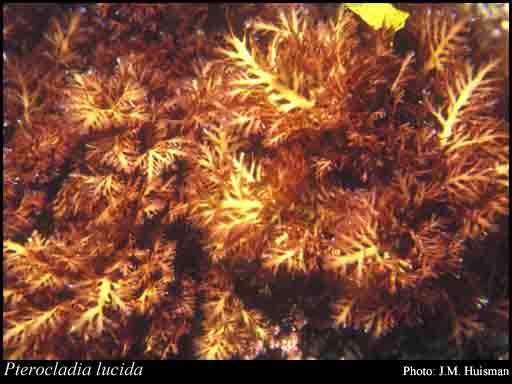
Scientific Description
Habit and structure. Thallus red-brown to dark red, 8–40 cm long, cartilaginous, with few to several erect, bi- to tripinnate, complanate fronds from a fibrous to hapteroid, stoloniferous base. Axes flat, 3–4 mm broad centrally and above, with a thicker midrib below, with broad apices when actively growing but tapering in some plants, alternately distichously branched at intervals of (1–)2–5(–10) mm, pinnae with rounded axils, not or partly denuded below. Pinnae flat, 2–10 cm long and 1–3(–4) mm broad, thicker centrally, slightly basally constricted, usually with broad apices. Pinnules alternate, flat, 2–5 mm long and 0.3–1 mm broad, basally slightly constricted. Holdfast discoid, becoming stoloniferous; epilithic. Structure. Cortex 3–5 cells thick, outer cells in surface view in rows spreading outwards, rounded with the protoplast 3–5 µm across; medulla 7–12 cells thick with hyphae in older (midrib) parts; rhizines profuse, especially in outer medulla in older parts.
Reproduction. Cystocarps single, lying near the end of pinnules, round to ovate, 600–1000 µm across, unilocular with 1–4 ostioles in the raised pericarp; carposporophyte broad-based, with carposporangia in short chains, maturing apically, clavate to ovoid, 14–22 µm in diameter. Spermatangial sori on pinnules, spermatangial initials cut off from outer cortical cells, elongate, 1.5–2.5 µm in diameter. Tetrasporangial sori in small pinnules or on ovate to elongate compressed ramuli on margins of pinnae or pinnules, 1–2(–3) mm long and 300–800 µm broad; medulla slight; tetrasporangia in regular arrangement near apex of sori, becoming mixed, derived from cortical cells and lying in the inner cortex, ovoid, 20–30 µm in diameter, cruciately divided (usually decussately).
Distribution. New Zealand. Murchison R. mouth (Kalbarri), W. Aust., around southern Australia and Tas to Coffs Harbour, N.S.W.
Habitat. P. lucida is a common subtidal species on rough-water coasts.
[After Womersley, Mar. Benthic Fl. Southern Australia IIIA: 137–139 (1994)]
Distribution
- IBRA Regions
- Esperance Plains, Geraldton Sandplains, Jarrah Forest, Swan Coastal Plain, Warren.
- IBRA Subregions
- Geraldton Hills, Perth, Recherche, Southern Jarrah Forest, Warren.
- IMCRA Regions
- Abrolhos Islands, Central West Coast, Leeuwin-Naturaliste, WA South Coast, Zuytdorp.
- Local Government Areas (LGAs)
- Augusta Margaret River, Bunbury, Busselton, Carnarvon, Cockburn, Coorow, Cottesloe, Dandaragan, Esperance, Greater Geraldton, Irwin, Joondalup, Mandurah, Manjimup, Northampton, Rockingham.