- Reference
- Spec.Alg. 15 (1820)
- Conservation Code
- Not threatened
- Naturalised Status
- Native to Western Australia
- Name Status
- Current
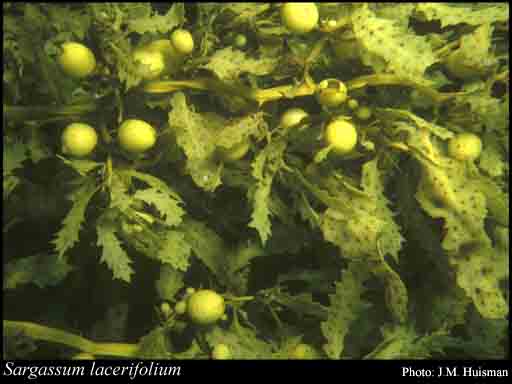
Scientific Description
Habit and structure. Thallus medium to dark brown, 10–60 cm long, with a simple or branched stipe 1–3 cm long, terete, 2–3 mm in diameter, with no or slight branch residues, bearing apically and radially 1–6 primary branches. Holdfast discoid-conical, 0.5–2 cm across, usually with a single stipe; epilithic. Primary branches 10–50 cm long, axes robust, triquetrous, 2–3 mm broad below, bearing tristichously arranged but displaced, simple, retroflex, laterals, becoming denuded below. Laterals (lower) 4–10 cm long, (1–)1.5–3 cm broad, usually slightly undulate, margins usually strongly spinous or slightly to deeply incised, grading gradually or abruptly to upper laterals 2–8 cm long and 2–10 mm broad, usually deeply incised, often lost from old branches. Vesicles absent to plentiful, petiolate, subspherical, (4–)6–9 mm in diameter, often with a terminal leaflet 2–10 mm long.
Reproduction. Thalli monoecious. Receptacles bisexual, single or often clustered on upper laterals, petiolate, simple, (2–)5–10(–17) mm long and (1–)2–3 mm broad, distinctly triquetrous usually with prominent spines along the ridges, with scattered ostioles on the receptacle surfaces. Conceptacles unisexual or occasionally bisexual; oogonia sessile, ovoid, 140–180 µm long and 80–120 µm in diameter, few per conceptacle; antheridia sessile or on short, branched, paraphyses, clavate to ovoid, 22–30 µm long and 8–14 µm in diameter.
Distribution. From Port Gregory, W. Aust., to Pebbly Beach, N of Batemans Bay, N.S.W., and around Tas.
[After Womersley, Mar. Benthic Fl. Southern Australia II: 438–440 (1987)]
Distribution
- IBRA Regions
- Jarrah Forest, Swan Coastal Plain.
- IBRA Subregions
- Perth, Southern Jarrah Forest.
- IMCRA Regions
- Abrolhos Islands, Central West Coast, Leeuwin-Naturaliste, WA South Coast.
- Local Government Areas (LGAs)
- Albany, Augusta Margaret River, Cockburn, Dandaragan, Esperance, Greater Geraldton, Joondalup, Northampton, Rockingham.