- Reference
- Syst.Alg. 297 (1824)
- Conservation Code
- Not threatened
- Naturalised Status
- Native to Western Australia
- Name Status
- Current
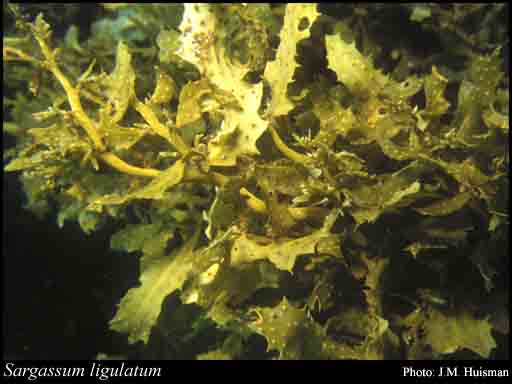
Scientific Description
Habit and structure. Thallus pale to medium brown, 15–50 cm tall, with a conical holdfast 10–23 mm diam. Primary axes terete to subterete, smooth, 3–7 mm long, 2.0–2.5 mm diam. Primary branches smooth or wrinkled, flattened, with sharp edges, 3–6 mm wide, 1.0–1.5 mm thick. Primary laterals alternate, linear-lanceolate, 25–100 mm long, 17–20 mm wide; margins undulate to serrate; apices obtuse; base subsymmetrical, narrowly cuneate, arising directly from the stem and lacking a distinct stalk. Secondary branches smooth to wrinkled, compressed, 2–3 mm diam. Secondary laterals linear-lanceolate to lanceolate, 10–70 mm long, 8–20 mm wide; margins serrate to dentate; apices acute or obtuse; base cuneate, subsymmetrical; cryptostomata prominent. Vesicles spherical, mutic, 3.0–9.5 mm diam., with a flattened or leaf-like stalk usually longer than the vesicle, occasionally extending into the vesicle as a small wing or thickened rib; cryptostomata large and raised. Receptacles monoecious, compressed and leaf-like, solitary, cymose or subalternate, 4–15 mm long, 2–4 mm wide, occasionally intermixed with leaves and vesicles, simple or once-divided, with rounded apices, either smooth or spinous across the margins. Conceptacles bisexual; oogonia egg-shaped, 75–160 µm long, 70–120 µm wide; antheridia egg-shaped, on long stalks, 14–30 µm long, 7–20 µm wide.
Distribution. Known only from the west coast of W.A.
Habitat. Epilithic in the subtidal.
[After Dixon & Huisman, Algae of Australia: Mar. Benthic Algae of North-western Australia, 1. Green and Brown Algae 257(2015)]
Distribution
- IBRA Regions
- Carnarvon, Geraldton Sandplains, Northern Kimberley.
- IBRA Subregions
- Cape Range, Geraldton Hills, Mitchell.
- IMCRA Regions
- Abrolhos Islands, Canning, Central West Coast, Kimberley, Leeuwin-Naturaliste, Ningaloo, Pilbara (offshore).
- Local Government Areas (LGAs)
- Ashburton, Broome, Carnarvon, Cockburn, Derby-West Kimberley, Exmouth, Greater Geraldton, Irwin, Northampton, Wyndham-East Kimberley.