- Reference
- Spec.Alg. 1:24 (1820)
- Conservation Code
- Not threatened
- Naturalised Status
- Native to Western Australia
- Name Status
- Current
Scientific Description
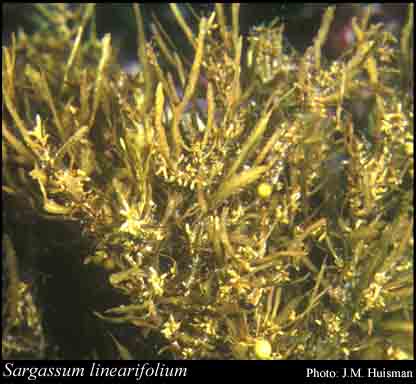
Habit and structure. Thallus dark brown, 10–50 cm long, with a simple stipe 1–3(–6) cm long, more or less terete, 2–3 mm in diameter, with rounded branch residues, bearing apically and radially 2–4(–6) primary branches. Holdfast discoid-conical, 3–15(–30) mm across, bearing 1–6 (or more) stipes. Primary branches 10–45 cm long, densely covered throughout their length with short secondary branches 2–5 cm long and bearing slender, linear, laterals and crowded tufts of receptacles when mature; branch axes terete to angular, sometimes with short spines, radially branched. Laterals (lower) 3–8(–10) cm long, (2–)3–5(–8) mm broad, relatively thick, simple or rarely furcate, linear to lanceolate, entire or with occasional small spines, costate, usually with prominent scattered cryptostomata; upper laterals 1.5–8 cm long, 1–2(–3) mm broad, linear, entire or occasionally with a few spines. Vesicles axillary, petiolate, subspherical to slightly ovoid, 3–5 mm in diameter, mutic or rarely mucronate.
Reproduction. Thalli monoecious. Receptacles unisexual or bisexual, forming dense clusters 3–10 mm long, much branched furcately or laterally, terete, 0.6–1.2 mm in diameter, drying slightly verrucose, apices rounded, with scattered ostioles. Conceptacles unisexual; oogonia sessile, ovoid to subspherical, (100–)160–240 µm long and (60–)90–220 µm in diameter, few per conceptacle; antheridia sessile or on short, branched, paraphyses, ovoid, (18–)20–28 µm long and (8–)10–18 µm in diameter.
Distribution. From Horrocks Beach, W. Aust. (probably further north), around southern Australia to N.S.W.; doubtfully from the N coast of Tas.
Habitat. S. linearifolium is often common in rock pools or the uppermost sublittoral on coasts of strong to moderate water movement.
[After Womersley, Mar. Benthic Fl. Southern Australia II: 440–441 (1987)]
Distribution
- IBRA Regions
- Geraldton Sandplains, Jarrah Forest, Swan Coastal Plain, Warren.
- IBRA Subregions
- Geraldton Hills, Perth, Southern Jarrah Forest, Warren.
- IMCRA Regions
- Abrolhos Islands, Central West Coast, Kimberley, Leeuwin-Naturaliste, Ningaloo, Pilbara (offshore), Shark Bay, WA South Coast.
- Local Government Areas (LGAs)
- Albany, Ashburton, Augusta Margaret River, Busselton, Capel, Carnarvon, Cockburn, Coorow, Cottesloe, Dandaragan, Derby-West Kimberley, Esperance, Exmouth, Greater Geraldton, Irwin, Karratha, Northampton, Rockingham, Shark Bay, Stirling, Wanneroo, Wyndham-East Kimberley.