- Reference
- Algae Brit. xxxvi (1830)
- Conservation Code
- Not threatened
- Naturalised Status
- Native to Western Australia
- Name Status
- Current
Scientific Description
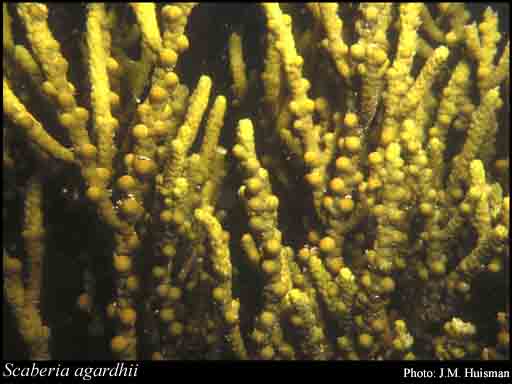
Habitat and structure. Thallus medium brown, drying darker brown, 20–100(–200) cm long, with a short stipe bearing several primary branches (1–)4–10 cm long, with slender, radial, smooth, laterals; some laterals developing as long, branched, axes, naked below and 1–2 mm in diameter, covered above with laterally adjacent, peltate, determinate, much lobed laterals which give the branch an irregularly verrucose appearance; such branches 4–6(–8) mm in diameter. Holdfast discoid-conical, 3–10 mm across; epilithic. Determinate laterals 1–2 mm high and 2–4 mm across, with a stalk 0.5–1 mm long and the peltate head formed of much branched, successively slenderer, ramuli. Vesicles scattered, formed within the peltate laterals, appearing as swellings, 3–7 mm in diameter. Growth from a single, three-sided, apical cell in an apical depression. Structure of central medulla of elongate cells and hyphae and an outer cortex of isodiametric cells with a surface meristoderm; outer cells densely phaeoplastic.
Reproduction. Thalli monoecious. Conceptacles on short branchlets with no or few vesicles, within the walls of the peltate laterals, bisexual, with scattered ostioles; oogonia sessile, ovoid, 95–240 µmlong and 60–90 µmin diameter, with a single egg; antheridia on branched paraphyses, elongate-ovoid, 25–45 µmlong and 8–15 µmin diameter; simple, slender, paraphyses present in conceptacles.
Distribution.From the Houtman Abrolhos, W. Aust., around southern Australia and N Tas, (to Oyster Bay), to Collaroy, N.S.W. Lord Howe I.
Habitat. S. agardhii is common in moderate to strong water movement on most of the southern Australian coast, from low tide level to about 40 m deep.
[After Womersley, Mar. Benthic Fl. Southern Australia II: 354 (1987)]
Distribution
- IBRA Regions
- Esperance Plains, Geraldton Sandplains, Jarrah Forest, Swan Coastal Plain.
- IBRA Subregions
- Geraldton Hills, Perth, Recherche, Southern Jarrah Forest.
- IMCRA Regions
- Abrolhos Islands, Central West Coast, Leeuwin-Naturaliste, WA South Coast.
- Local Government Areas (LGAs)
- Albany, Augusta Margaret River, Busselton, Cambridge, Capel, Cockburn, Cottesloe, Dandaragan, Esperance, Greater Geraldton, Irwin, Northampton, Rockingham.