- Reference
- Phycologia 278, figs 23-35 (1986)
- Conservation Code
- Not threatened
- Naturalised Status
- Native to Western Australia
- Name Status
- Current
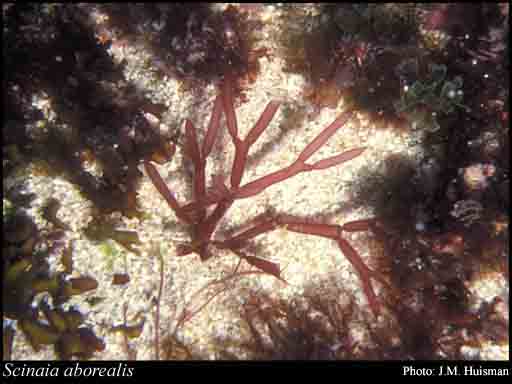
Scientific Description
Habit and structure. Thallus medium grey-red to dark red, sometimes brownish, 5–20(–38) cm high, subdichotomously branched every 1–3(–11) cm usually with constrictions at points of branching, segments 1.5–3 mm in diameter below, 3–4 mm in diameter above, ultimate segments tapering to a point. Holdfast discoid, 1.5–2 mm across; epilithic. Structure multiaxial, with a central core of slender, entwined filaments 2–3(–6) µm in diameter, from which radiate medullary filaments giving rise to a cortex of 1–2 layers of ovoid, rhodoplastic cells 10–15 µm in diameter and an outer layer of colourless utricles, polygonal in surface view, 25–40 µm long and 18–25(–30) µm in diameter.
Reproduction. Sexual thalli monoecious. Carpogonial branches 3-celled, developed on outer medullary cells near the apices, with the hypogynous cell producing four sterile branches, usually a 3-celled branch, two 2-celled branches and a 1-celled branch, and the basal cell producing several lateral branches which form the involucre after fertilization. Fertilized carpogonium producing 3–4 initials with the gonimoblast filaments developing chains of ovoid to pyriform carposporangia 15–20 µm long and 5–7 µm in diameter; fusion cell present. Cystocarps 200–250 µm in diameter, ostiolate, with a well developed involucre. Spermatangial branches arising from hypodermal cortical cells and projecting between surface utricles, 2–3 cells long, producing 2–3 spermatangial initials each with 1–3 ovoid spermatangia 2–3 µm in diameter.
Distribution. Greenough Point (10 km S of Geraldton), W. Aust., around southern Australia (not Tas.) to Coffs Harbour, N.S.W.; Norfolk I.
[After Womersley, Mar. Benthic Fl. Southern Australia IIIA: 101–103 (1994)]
Distribution
- IBRA Regions
- Swan Coastal Plain.
- IBRA Subregions
- Perth.
- IMCRA Regions
- Central West Coast, Leeuwin-Naturaliste.
- Local Government Areas (LGAs)
- Cockburn, Dandaragan, Mandurah, Rockingham.