- Reference
- Algae Brit. synop. xxxiv (1830)
- Conservation Code
- Not threatened
- Naturalised Status
- Native to Western Australia
- Name Status
- Current
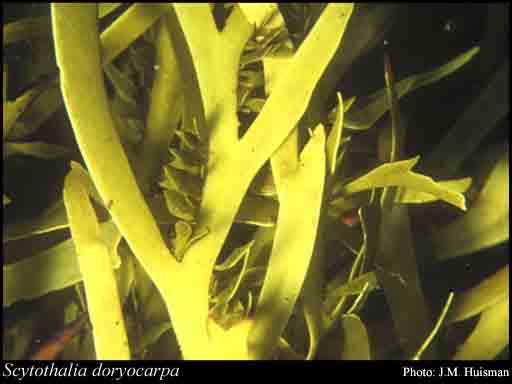
Scientific Description
Habit and structure. Thallus medium to dark brown, 0.5–2 m long, much branched irregularly laterally and essentially complanately, with long axes or primary branches bearing marginally alternate, distichous, laterals; stipe 1–12 cm long, subterete, 2–8(–10) mm in diameter. Holdfast 1–3(–6) cm across, developing a circular, raised, rim to the discoid-conical centre, with closely adjacent, simple or branched, haptera 1–4 cm long; epilithic. Axes or primary branches slightly flexuous, 3–6 mm broad, 1–2(–4) mm thick, bearing alternate, simple, laterals at intervals of 0.4–3 cm. Laterals usually curved, linear but tapering above, basally not or slightly constricted, 5–8(–12) cm long and (2–)3–6 mm broad. Growth from 1–2 four-sided apical cells in an apical groove. Structure with a medulla of elongate cells and hyphae, and a cortex of isodiametric cells with a surface meristoderm increasing the cortex; outer cells densely phaeoplastic.
Reproduction. Thalli monoecious. Receptacles clustered (few to many) along the adaxial margins of laterals and spreading to the adjacent margin of the parent branch, strongly compressed, ensiform to lanceolate, often rostellate, 10–15 mm long and (1–)2–5 mm broad. Conceptacles scattered over the flat surfaces, usually unisexual, occasionally bisexual; female conceptacles with simple or basally branched, moniliform, paraphyses, with ovoid cells 12–20 µmin diameter; oogonia sessile, ovoid, with an apical mesochiton collar and a single egg, 160–280 µmlong and 60–150 µmin diameter; antheridia on branched paraphyses, elongate-ovoid, 24–42 µmlong and 6–12 µmin diameter.
Distribution. From Cliff Head, W. Aust., to Point Lonsdale, Vic., and the N coast of Tas.
Habitat. On rough-water coasts from low water mark to 44 m deep.
[After Womersley, Mar. Benthic Fl. Southern Australia II: 351 (1987)]
Distribution
- IBRA Regions
- Esperance Plains, Jarrah Forest, Mallee, Swan Coastal Plain, Warren.
- IBRA Subregions
- Eastern Mallee, Perth, Recherche, Southern Jarrah Forest, Warren.
- IMCRA Regions
- Central West Coast, Leeuwin-Naturaliste, WA South Coast.
- Local Government Areas (LGAs)
- Albany, Augusta Margaret River, Busselton, Cambridge, Cockburn, Cottesloe, Dandaragan, Dundas, Esperance, Irwin, Joondalup, Mandurah, Manjimup, Rockingham.