- Reference
- Fragm. (Mueller) 6:231 (1868)
- Conservation Code
- Not threatened
- Naturalised Status
- Native to Western Australia
- Name Status
- Current
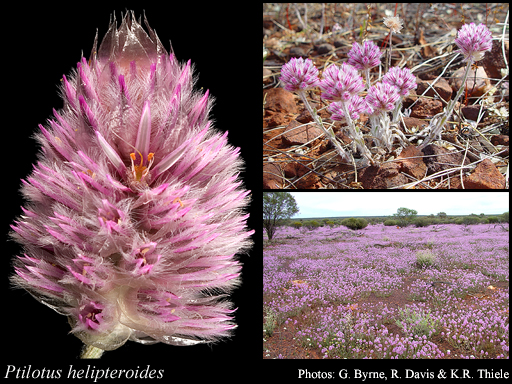
Erect to ascending annual, herb, 0.02-0.6 m high. Fl. pink-purple/pink-white, Apr to Oct. Red stony sand, sandy loam. Stony flats.
Scientific Description
Annuals, stems several, more or less erect, persistently hairy or glabrescent, with nodose hairs. Leaves present, 5-70 mm long, 2-10 mm wide, persistently hairy or glabrescent, with nodose hairs; basal rosette present; cauline leaves alternate. Spikes pink or magenta, ovoid, cylindrical or hemispherical, solitary or clustered, with densely arranged flowers. Bracts 6.8-7.2 mm long, colourless, glabrous, awned or mucronate, with an obscure midrib. Bracteoles 3.8-5 mm long, colourless, glabrous, awned or mucronate, with an obscure or a prominent midrib. Outer tepals 8.2-9.2 mm long, not entire. Inner tepals 7.5-8.7 mm long, with a basal tuft of hairs on inner face. Style 3-3.6 mm long, curved, obliquely fixed to ovary. Seeds 1.4-1.6 mm long, dull, orange or pale brown. Distribution: South West and Eremaean Botanical Region; IBRA regions: Carnarvon, Central Ranges, Coolgardie, Gascoyne, Gibbson Desert, Great Sandy Desert, Great Victoria Desert, Little Sandy Desert, Murchison, Pilbara, Yalgoo.
Distribution
- IBRA Regions
- Avon Wheatbelt, Carnarvon, Central Ranges, Coolgardie, Gascoyne, Gibson Desert, Great Sandy Desert, Great Victoria Desert, Little Sandy Desert, Murchison, Nullarbor, Pilbara, Yalgoo.
- IBRA Subregions
- Ashburton, Augustus, Cape Range, Carlisle, Carnegie, Central, Chichester, Eastern Goldfield, Eastern Murchison, Fortescue, Hamersley, Lateritic Plain, Mackay, Mann-Musgrave Block, McLarty, Merredin, Roebourne, Rudall, Shield, Southern Cross, Tallering, Trainor, Western Murchison, Wooramel.
- IMCRA Regions
- Pilbara (nearshore).
- Local Government Areas (LGAs)
- Ashburton, Carnarvon, Coolgardie, Cue, East Pilbara, Exmouth, Kalgoorlie-Boulder, Karratha, Laverton, Leonora, Meekatharra, Menzies, Mount Magnet, Murchison, Ngaanyatjarraku, Perenjori, Sandstone, Upper Gascoyne, Wiluna, Yalgoo.