- Reference
- Bot.Zeitung (Berlin) 3:50 (1845)
- Conservation Code
- Not threatened
- Naturalised Status
- Native to Western Australia
- Name Status
- Current
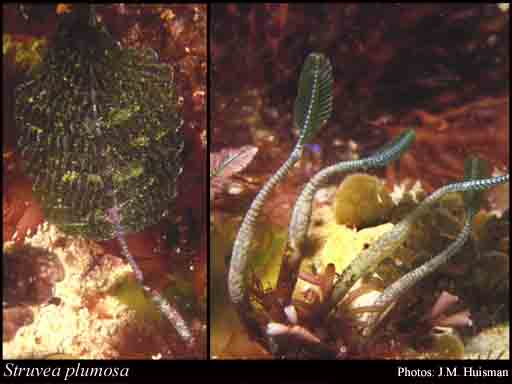
Scientific Description
Habit and structure. Thallus light to medium green, 3–15(–20) cm high, epilithic, with a mass of densely clustered, elongate-clavate stipe cells each 2–8 cm long and (1–)2–4(–5) mm in diameter, often broadest in their mid part, with numerous annular constrictions throughout their length or confined to their upper and lower narrower parts; thallus often remaining as the basal stipes only, especially near the distributional margins, in shallow water and in winter. Blades produced from ends of stipes, largely complanate, ovate to elongate, sometimes obovate, reticulate, 1–10(–17) cm long and 0.5–4(–12) cm across. Axial row of blade cells (1–)2–6(–10) mm long and 0.3–1.5 mm in diameter, each producing from its apex opposite primary branches of smaller cells except for the outermost few which curve towards the blade apex and attach to a subapical cell of the next anterior primary row, producing only inner (adaxial) secondary branches; most primary cells producing opposite secondary branches which grow towards the primary rows above and below, attaching to a primary cell or the base of a secondary cell to give a zig-zag appearance; tertiary cells formed similarly but often not attaching to secondary cells; all branches of the net lie in essentially one plane but distortion due to crowding frequently occurs; attachment of younger to older cells by means of small, isodiametric tenacula cells; chloroplast openly reticulate, with numerous pyrenoids.
Reproduction. Unknown.
Distribution. From Port Denison, W. Aust., around southern Australia to Encounter Bay (Victor Harbor), S. Aust.
Habitat. Epilithic, from about low tide level to 33 m deep.
[After Womersley, Mar. Benthic Fl. Southern Australia I: 218–220 (1984)]
Distribution
- IBRA Regions
- Carnarvon, Esperance Plains, Swan Coastal Plain, Warren.
- IBRA Subregions
- Cape Range, Perth, Recherche, Warren.
- IMCRA Regions
- Abrolhos Islands, Central West Coast, Leeuwin-Naturaliste, Pilbara (offshore), WA South Coast.
- Local Government Areas (LGAs)
- Armadale, Ashburton, Cockburn, Coorow, Dandaragan, Esperance, Gingin, Greater Geraldton, Irwin, Manjimup, Northampton, Rockingham.