- Reference
- Spec.Gen.Ord.Alg. 429 (1876)
- Conservation Code
- Not threatened
- Naturalised Status
- Native to Western Australia
- Name Status
- Current
Scientific Description
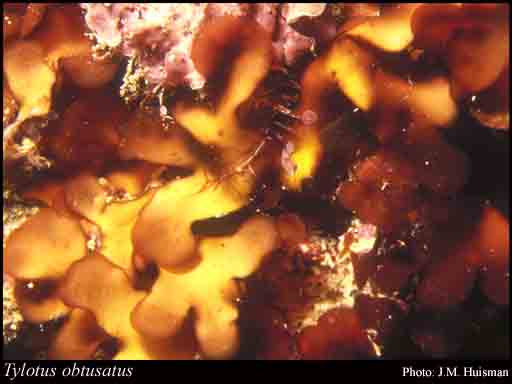
Habit and structure. Thallus dark red-brown, fading to yellow-brown, cartilaginous, 5–15 cm long and more or less decumbent, irregularly subdichotomously and complanately branched with occasional marginal proliferations, branches 5–12 mm broad and 200–400 µm thick; basal 2–3 cm prostrate, attached by stout, terete, simple haptera 2–15 mm long; epilithic. Structure pseudoparenchymatous without a differentiated medulla, inner cells ovoid, 40–60(–80) µm in diameter, decreasing in size to the outer cortex with the surface cells radially elongate, 4–6 µm in diameter. Rhodoplasts discoid, several per cell.
Reproduction. Sexual thalli monoecious, with female gametangia on the under surface and male on the upper surface of branches; procarpic. Carpogonial branches 3-celled, scattered in the outer cortex, laterally attached and reflexed with the adjacent cortex developing into anticlinal filaments. Supporting cell acting as the auxiliary cell, forming a large fusion cell and a reticulum of gonimoblast filaments and vegetative cells from which outer cells cut off single, subspherical to ovoid, carposporangia 4–8 µm in diameter, with the surface of the carposporophyte becoming markedly undulate. Pericarp thick, derived from anticlinal filaments of the outer cortex, ostiolate. Cystocarps broadly domed, 1–2 mm across, basally constricted, scattered across the lower surface of fronds. Spermatangia in small sunken clusters developed from cortical cells on the upper surface of fronds, ovoid, 2–3 µm in diameter. Tetrasporangial nemathecia swollen, 10–20 mm long and 2–6 mm broad, on the upper surface of fronds within a few centimetres of apices. Tetrasporangia in the surface layer and also buried deeper in old nemathecia when sterile paraphyses continue growth, laterally basally attached, elongate-ovoid to clavate, 25–35 µm long and 7–10 µm in diameter, zonately divided.
Distribution. Champion Bay, W. Aust., to Inverloch, Vic.
[After Womersley, Mar. Benthic Fl. Southern Australia IIIA: 328–330 (1994)]
Distribution
- IBRA Regions
- Geraldton Sandplains, Swan Coastal Plain.
- IBRA Subregions
- Geraldton Hills, Perth.
- IMCRA Regions
- Abrolhos Islands, Central West Coast, Leeuwin-Naturaliste, WA South Coast.
- Local Government Areas (LGAs)
- Cockburn, Dandaragan, Esperance, Greater Geraldton, Irwin, Mandurah, Rockingham, Wanneroo.