- Reference
- Nuytsia 2:341-345 (1979)
- Conservation Code
- Not threatened
- Naturalised Status
- Native to Western Australia
- Name Status
- Current
Perennial, herb, 0.1-0.4 m high. Fl. pink-purple, May to Aug. Sandy soils. Stony hills.
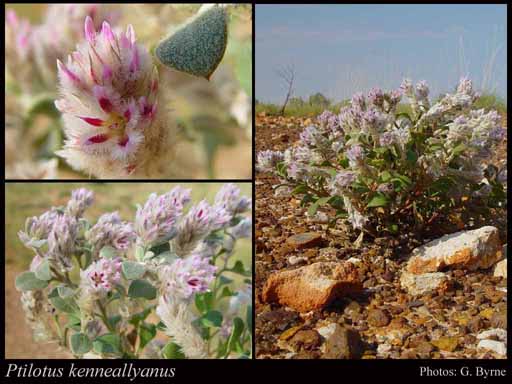
Scientific Description
Shrubs, stems several, more or less erect, persistently hairy or glabrescent, with dendritic hairs. Leaves present, 8-45 mm long, 3-20 mm wide, persistently hairy or glabrescent, with dendritic hairs; basal rosette absent; cauline leaves alternate. Spikes pink or magenta, ovoid, cylindrical or hemispherical, clustered, with densely arranged flowers. Bracts (3.2-)4.2-5.8 mm long, coloured, hairy, awned or mucronate, with a prominent midrib. Bracteoles (3.5-)4.2-5.5 mm long, coloured or colourless, hairy, awned or mucronate, with a prominent midrib. Outer tepals 5.7-8.3 mm long, entire or not entire. Inner tepals 4.4-7.2 mm long, glabrous within. Style (0.8-)1-1.3(-1.5) mm long, curved, obliquely fixed to ovary. Seeds (1.2-)1.4-1.6 mm long, glossy, brown. Distribution: Northern and Eremaean Botanical Region; IBRA regions: Dampierland.
Distribution
- IBRA Regions
- Dampierland, Great Sandy Desert.
- IBRA Subregions
- McLarty, Pindanland.
- Local Government Areas (LGAs)
- Broome, Derby-West Kimberley.