- Reference
- Phycologia 9:117 (1970)
- Conservation Code
- Not threatened
- Naturalised Status
- Native to Western Australia
- Name Status
- Current
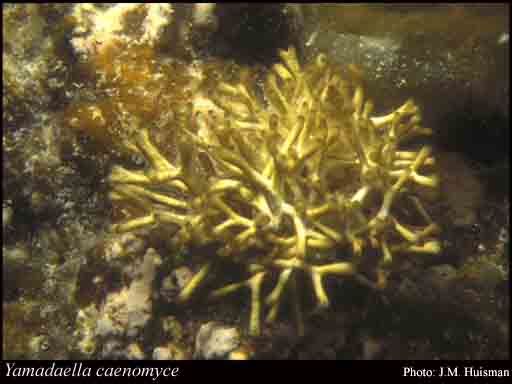
Scientific Description
Habit and structure. Thallus to 5 cm tall and spreading to 10 cm wide, grey-green to dark red, heavily calcified except near the apices, dichotomously or irregularly branched; dichotomies 1–2 (–5) mm apart. Axes to 500 μm diam. Medullary filaments 15–20 μm diam. Cortical filaments 4 or 5 times pseudodichotomous, 150–225 μm long; apical cells 8–12 μm diam.
Reproduction. Spermatangia 3–5 μm long. Carposporangia 18–30 × 13–15 μm.
Distribution. Widespread in tropical seas.
Habitat. Grows on rock in the intertidal regions or on coral platforms near low-water mark.
[After J.M. Huisman & S.-M. Lin in Algae of Australia: Marine Benthic Algae of North-western Australia, 2. Red Algae: 80 (2018); J.M. Huisman in Marine Plants of Australia: 24 (2019)]
Distribution
- IBRA Regions
- Dampierland, Pilbara.
- IBRA Subregions
- Pindanland, Roebourne.
- IMCRA Regions
- Abrolhos Islands, Kimberley, Leeuwin-Naturaliste, Pilbara (offshore), Zuytdorp.
- Local Government Areas (LGAs)
- Ashburton, Broome, Cockburn, Greater Geraldton, Karratha, Shark Bay, Wyndham-East Kimberley.