- Reference
- Ofversigt af Forhandligar: Kongl. Svenska Vetenskaps-Akademien 438 (1870)
- Conservation Code
- Not threatened
- Naturalised Status
- Native to Western Australia
- Name Status
- Current
Scientific Description
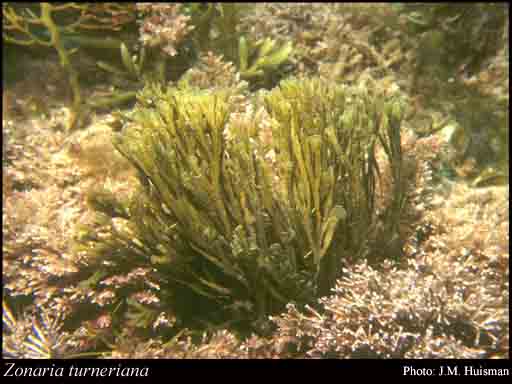
Habit and structure. Thallus dark brown, (5–)10–20(–25) cm long, broadly flabellate when young, becoming much branched and essentially complanate, with axes and lower branches stupose and 2–5(–8) mm broad, arising from a matted rhizoidal holdfast (2–)5–15 mm across and 2–10 mm long; epilithic. Fronds complanate, irregularly laterally branched, branches more or less linear or with occasional short spinous laterals, 2–5(–10) mm broad in mid and upper parts with no or slight growth zones and sometimes with a slight, darker, midrib, broader in juvenile plants near their base. Structure 8–10 cells and 120–160(–180) µm thick, with cells in regular rows in transverse section and the cortical cells nearly all paired, (2–)4–6(–7) to each medullary cell lengthwise (with the subcortical layer sometimes once subdivided), 8–14 µm across (when paired) and L/B(0.7–)1–1.5(–2.5). Hair tufts inconspicuous, slight.
Reproduction. Sori of sporangia amongst paraphyses on upper and mid branches; sporangia clavate to pyriform, 90–180 µm long and 70–115 µm in diameter, with 8 spores, without a stalk cell; paraphyses 7–10 cells and 250–400 µm long, clavate with elongate-ovoid end cells 30–40 µm in diameter. Sexual reproduction unknown in Australian plants .
Distribution. From Kalbarri, W. Aust., to Port Phillip Heads, Vic., and around Tas.
Habitat. Z. turneriana appears to be typically a deep water (to 30 m) species, and deeper specimens have broader branches.
[After Womersley, Mar. Benthic Fl. Southern Australia II: 252–253 (1987)]
Distribution
- IBRA Regions
- Esperance Plains, Geraldton Sandplains, Swan Coastal Plain, Warren.
- IBRA Subregions
- Geraldton Hills, Perth, Recherche, Warren.
- IMCRA Regions
- Abrolhos Islands, Central West Coast, Leeuwin-Naturaliste, WA South Coast.
- Local Government Areas (LGAs)
- Augusta Margaret River, Busselton, Cockburn, Coorow, Dandaragan, Esperance, Greater Geraldton, Irwin, Northampton, Wanneroo.