- Reference
- J.Roy.Soc.Western Australia 53:4-6, Fig. 3 (1970)
- Conservation Code
- Priority Four
- Naturalised Status
- Native to Western Australia
- Name Status
- Current
Compact, perennial shrub, to 0.5 m high, soft grey foliage. Fl. white/pink, May or Sep. Stony hills and screes.
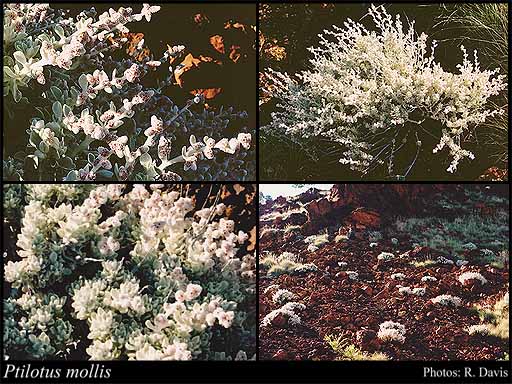
Scientific Description
Shrubs or perennial herbs, stems single, more or less erect, persistently hairy, with nodose hairs. Leaves present, 5-30 mm long, 3-20 mm wide, persistently hairy, with nodose hairs; basal rosette absent; cauline leaves alternate. Spikes white or pink, ovoid or cylindrical, clustered, with densely arranged flowers. Bracts 1.5-2.2 mm long, colourless, hairy, not awned or mucronate, with an obscure midrib. Bracteoles 2.5-3 mm long, colourless, hairy, not awned or mucronate, with an obscure midrib. Outer tepals 3-3.3(-3.5) mm long, entire. Inner tepals 2.7 mm long, glabrous within. Style 0.4 mm long, straight, centrally fixed to ovary. Distribution: Eremaean Botanical Region; IBRA regions: Little Sandy Desert, Pilbara.
Distribution
- IBRA Regions
- Little Sandy Desert, Pilbara.
- IBRA Subregions
- Chichester, Hamersley, Roebourne, Rudall.
- Local Government Areas (LGAs)
- Ashburton, East Pilbara, Port Hedland.