- Reference
- J.Proc.Linn.Soc.,Bot. 3:122 (1859)
- Conservation Code
- Not threatened
- Naturalised Status
- Native to Western Australia
- Name Status
- Current
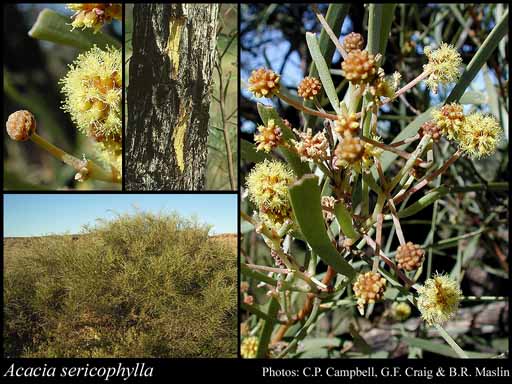
Gnarled tree or shrub, to 12 m high, bark grey, thick and spongy with deep longitudinal fissures which are yellow inside; phyllodes light green or grey-green, often pendant; inflorescences globular. Red, white or brown sand, gravelly loam, granite. Sandplains, damp areas, water-courses.
Distribution
- IBRA Regions
- Carnarvon, Central Kimberley, Central Ranges, Dampierland, Darwin Coastal, Gascoyne, Gibson Desert, Great Sandy Desert, Little Sandy Desert, Ord Victoria Plain, Pilbara, Tanami, Victoria Bonaparte.
- IBRA Subregions
- Augustus, Cape Range, Chichester, Fortescue, Hamersley, Hart, Keep, Lateritic Plain, Mackay, Mann-Musgrave Block, McLarty, Pentecost, Pindanland, Purnululu, Roebourne, Rudall, South Kimberley Interzone, Tanami Desert, Trainor.
- IMCRA Regions
- Pilbara (nearshore).
- Local Government Areas (LGAs)
- Ashburton, Broome, Carnarvon, Derby-West Kimberley, East Pilbara, Exmouth, Halls Creek, Karratha, Meekatharra, Ngaanyatjarraku, Port Hedland, Wiluna, Wyndham-East Kimberley.