- Reference
- J.Roy.Soc.Western Australia 89:124-126, Fig. 1 (2006)
- Conservation Code
- Priority Two
- Naturalised Status
- Native to Western Australia
- Name Status
- Current
Sprawling shrub (or subshrub), to 0.4 m high. Red-brown gravelly sand, white-pink, grey-brown clayey sand and loam, over laterite. Undulating sites.
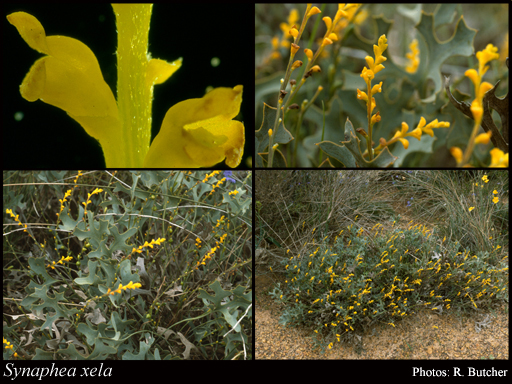
Scientific Description
Shrubs; branchlets hairy. Leaves alternate, 135-220 mm long, glabrous; petiole glabrous; lamina flat, twice or more divided, pinnately divided, deeply divided; distance from base of leaf to lowest lobe 90-150 mm; terminal leaf lobe 5-10 mm long, 3-5 mm wide; lowest lobes 20-50 mm long. Inflorescences yellow; scape 180-320 mm long; floral bracts 1.3-1.5 mm long. Perianth 4-5.2 mm long, glabrous; adaxial tepal 4-5.2 mm long; abaxial tepal 3-3.5 mm long; ovary hairy, style glabrous; style including stigmatic disc 3 mm long, entire; stigma 1 mm long, 0.5 mm wide. Flowers in August or September. Occurs in the in the Geraldton Sandplains (GS) IBRA subregion(s). : Conservation code Priority Two (P2).
Distribution
- IBRA Regions
- Geraldton Sandplains.
- IBRA Subregions
- Lesueur Sandplain.
- Local Government Areas (LGAs)
- Carnamah, Dandaragan, Three Springs.