- Reference
- Nuytsia 17:100-104, Fig.2 (2007)
- Conservation Code
- Priority Three
- Naturalised Status
- Native to Western Australia
- Name Status
- Current
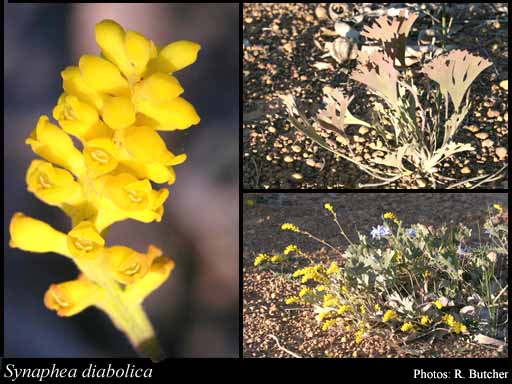
Clumped, sprawling shrub (subshrub), 0.2-0.6 m high. Dry, yellow-brown laterite soil with laterite gravel. In undulating areas.
Scientific Description
Shrubs; branchlets hairy. Leaves alternate, 55-235 mm long, hairy; petiole hairy; lamina flat, twice or more divided, tripartitely divided, deeply divided, indumentum spreading; distance from base of leaf to lowest lobe 70-150 mm; terminal leaf lobe 5-10 mm long, 2-5 mm wide; lowest lobes 30-55 mm long. Inflorescences yellow; scape 115-245 mm long; floral bracts 1.5-2.3 mm long. Perianth 5-6.7 mm long, hairy; adaxial tepal 5-6.7 mm long; abaxial tepal 5-6 mm long; ovary hairy, style glabrous; style including stigmatic disc 3.5-4.5 mm long, lobed; stigma 1-1.2 mm long, 0.8-1 mm wide. Flowers in August, September or October. Occurs in the South-west (SW) Botanical Province(s), in the Jarrah Forest (JF) IBRA subregion(s). : Conservation code Priority Three (P3).
Distribution
- IBRA Regions
- Jarrah Forest.
- IBRA Subregions
- Northern Jarrah Forest, Southern Jarrah Forest.
- Local Government Areas (LGAs)
- Beverley, Busselton, Northam, York.