- Reference
- Austral.Syst.Bot. 20:69 (2007)
- Conservation Code
- Not threatened
- Naturalised Status
- Native to Western Australia
- Name Status
- Current
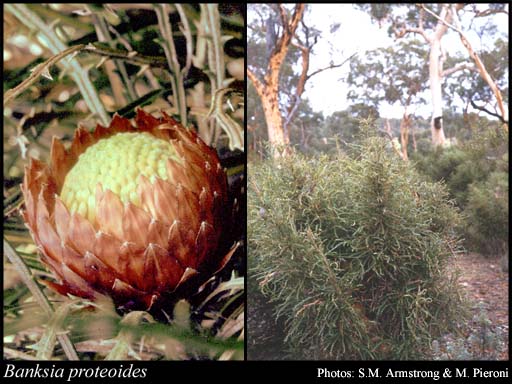
Dense, non-lignotuberous shrub, 0.4-3 m high, to 2 m wide. Fl. cream-yellow-orange/brown, Jul to Oct. Sandy gravelly soils, sandy loam. Lateritic hills.
Scientific Description
Shrubs, 2-3 m high; branchlets hairy. Leaves petiolate, alternate, 100-210 mm long, 8-15 mm wide, hairy; petiole 8-10 mm long; lamina flat, once divided, pinnately divided, deeply divided, teeth pointing outwards, with 10-20 lobes on each side, the margins recurved. Inflorescences yellow; innermost bracts 57-65 mm long, hairy or glabrous. Perianth 36-50 mm long, glabrous, without awns; pistil 40-45 mm long, curved, style glabrous. Follicles glabrous, obovate, 22-24 mm long. Flowers in June, July or August. Occurs in the South-west (SW) Botanical Province(s), in the Avon Wheatbelt (AW) or Jarrah Forest (JF) IBRA subregion(s).
Distribution
- IBRA Regions
- Avon Wheatbelt, Jarrah Forest.
- IBRA Subregions
- Katanning, Northern Jarrah Forest, Southern Jarrah Forest.
- Local Government Areas (LGAs)
- Brookton, Cuballing, Katanning, Narrogin, Northam, Pingelly, Wandering, West Arthur.