- Reference
- Sp.Pl. [Linnaeus] 2:732 (1753)
- Conservation Code
- Not threatened
- Naturalised Status
- Alien to Western Australia
- Name Status
- Current
Twining annual or perennial, herb or climber, to 3 m high. Fl. pink-purple, Feb or Jul or Oct to Nov. Sandy, loamy or clayey soils. Roadsides, stream banks, drains.
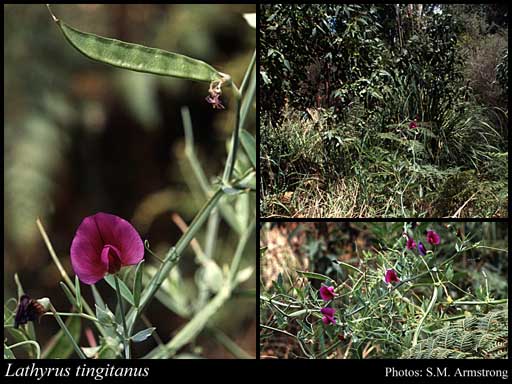
Scientific Description
Twining or climbing plants, herb. Stems flattened or winged, not spiny, glabrous; pustules or glands absent. Leaves or phylloclades clearly present, compound, alternate, not continuous with stem, 25-50 mm long, glabrous, flat with flat margins; margins lobed; tubercles absent; pustules or glands absent. Stipules present and persistent to older leaves, 10-20 mm long, without glands, ribless. Pedicel present, 5-7 mm long, glabrous. Bracteoles absent. Calyx 10-11 mm long, not accrescent, glabrous, ribbed; pustules or glands absent. Corolla 25-30 mm long, multicoloured, mostly pink, purple or white, with some pink, purple or white spots, streaks or blotches; claws present; standard 24-28 mm long, glabrous, not auriculate, wings 20 mm long, not auriculate, keel 20-24 mm long, not beaked, not auriculate, glabrous. Stamens at two different levels (filaments alternately long and short); filaments united in an open sheath with one free stamen, 13-14 mm long. Ovary stipitate, glabrous; style 24 mm long, glabrous, not bearded, flattened at apex. Fruit 65-90 mm long, 7-10 mm wide, stipitate, not constricted between the seeds, flat or compressed, glabrous, not beaked. Flowers in February, July, October and November. Occurs in the South-West Botanical Province, in the Jarrah Forest, Warren and Swan Coastal Plain IBRA regions.
Distribution
- IBRA Regions
- Jarrah Forest, Swan Coastal Plain, Warren.
- IBRA Subregions
- Northern Jarrah Forest, Perth, Southern Jarrah Forest, Warren.
- IMCRA Regions
- Leeuwin-Naturaliste, WA South Coast.
- Local Government Areas (LGAs)
- Albany, Armadale, Augusta Margaret River, Bridgetown-Greenbushes, Bunbury, Busselton, Denmark, Donnybrook-Balingup, Harvey, Kalamunda, Manjimup, Mundaring, Murray, Nedlands, South Perth, Waroona, West Arthur.