- Reference
- Sp.Pl. [Linnaeus] 2:774 (1753)
- Conservation Code
- Not threatened
- Naturalised Status
- Alien to Western Australia
- Name Status
- Current
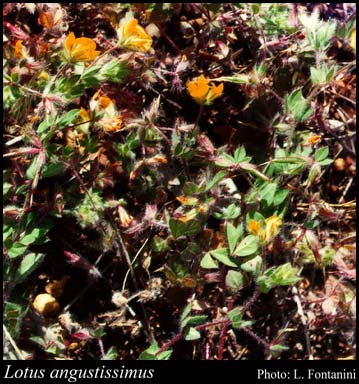
Slender, diffuse, prostrate or ascending annual or perennial, herb, 0.02-0.2 m high. Fl. yellow, Sep to Dec or Jan. Sand, loam, clay, gravelly soil. River edges, plains, pasture, road verges, disturbed or cultivated areas.
Scientific Description
Prostrate,spreading or scrambling, herb. Stems terete, not spiny, hairy; pustules or glands absent. Leaves or phylloclades clearly present, compound, alternate, not continuous with stem, 6-15 mm long, hairy, with simple hairs, flat with flat margins; margins entire; tubercles absent, leaflets 5, pinnately arranged, terminal leaflet present, stalked; pustules or glands absent. Stipules apparently absent even from the youngest leaves or present but early deciduous ( only visible on youngest leaves ). Pedicel present, 1-1.5 mm long, hairy. Bracteoles present and persistent. Calyx 6-7 mm long, not accrescent, hairy, with simple hairs, ribless; pustules or glands absent. Corolla 8.5-9 mm long, uniformly coloured, yellow; standard 5-7.8 mm long, glabrous, not auriculate, wings 5.8-7 mm long, auriculate, keel 8-8.5 mm long, not beaked, not auriculate, glabrous. Stamens ten; anthers 0.2 mm long, at two different levels (filaments alternately long and short); filaments united in an open sheath with one free stamen, 7-8 mm long. Ovary sessile or subsessile, glabrous; style 7.5-9 mm long, glabrous, not bearded, terete. Fruit dehiscent (a pod or follicle), sessile or subsessile, not constricted between the seeds, round in cross-section, not beaked. Flowers in January, September, October, November and December. Occurs in the South-West Botanical Province, in the Avon Wheatbelt, Jarrah Forest, Warren, Esperance and Swan Coastal Plain IBRA regions.
Distribution
- IBRA Regions
- Avon Wheatbelt, Esperance Plains, Jarrah Forest, Swan Coastal Plain, Warren.
- IBRA Subregions
- Dandaragan Plateau, Fitzgerald, Merredin, Northern Jarrah Forest, Perth, Southern Jarrah Forest, Warren.
- IMCRA Regions
- Leeuwin-Naturaliste.
- Local Government Areas (LGAs)
- Albany, Armadale, Augusta Margaret River, Boyup Brook, Bridgetown-Greenbushes, Bunbury, Busselton, Capel, Chittering, Collie, Dandaragan, Dardanup, Denmark, Harvey, Kalamunda, Kojonup, Mandurah, Manjimup, Melville, Mukinbudin, Mundaring, Murray, Perth, Plantagenet, Serpentine-Jarrahdale, Swan, Wanneroo, Waroona.