- Reference
- Sp.Pl. [Linnaeus] 2:722 (1753)
- Conservation Code
- Not threatened
- Naturalised Status
- Alien to Western Australia
- Name Status
- Current
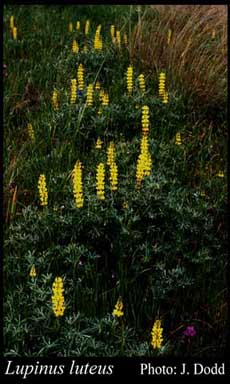
Spreading or erect annual, herb, 0.2-1 m high. Fl. yellow, Aug to Nov. Sand, loam clay. Winter-wet flats, occasionally naturalised in disturbed areas.
Scientific Description
Erect, herb. Stems flattened, not spiny, hairy; pustules or glands absent. Leaves or phylloclades clearly present, compound, alternate, 45-100 mm long, hairy, with simple hairs, flat with flat margins; margins entire; tubercles absent, leaflets 7-9, palmately arranged, terminal leaflet absent; pustules or glands absent. Stipules present and persistent to older leaves, 7-10 mm long, without glands, ribless. Pedicel present, 2-3 mm long, hairy. Bracteoles present and persistent, 5-5.5 mm long, hairy, not striate. Calyx 8-10 mm long, not accrescent, hairy, with simple hairs, ribless; pustules or glands absent. Corolla 15-16 mm long, uniformly coloured, yellow; claws present; standard 14-15 mm long, glabrous, not auriculate, wings 13-13.5 mm long, not auriculate, keel 12-15.5 mm long, beaked, not auriculate, glabrous. Stamens ten; anthers 1.2-1.5 mm long, at two different levels (filaments alternately long and short); filaments united in a closed sheath, 12-13 mm long. Ovary sessile or subsessile, hairy or glandular; style 16-17 mm long, hairy or glandular towards the base, bearded (with a tuft of hairs at apex), terete. Fruit dehiscent (a pod or follicle), sessile or subsessile, constricted between the seeds, flat or compressed, hairy (?) or glabrous (?), not beaked. Flowers in August, September, October and November. Occurs in the South-West Botanical Province, in the Jarrah Forest and Swan Coastal Plain IBRA regions.
Distribution
- IBRA Regions
- Jarrah Forest, Swan Coastal Plain.
- IBRA Subregions
- Northern Jarrah Forest, Perth, Southern Jarrah Forest.
- IMCRA Regions
- Leeuwin-Naturaliste.
- Local Government Areas (LGAs)
- Armadale, Belmont, Bridgetown-Greenbushes, Bunbury, Busselton, Dardanup, Gosnells, Harvey, Kalamunda, Manjimup, Melville, Murray, Perth, Serpentine-Jarrahdale, Swan, Wandering, Waroona.