
Service Notice

The Western Australian Herbarium’s collections management system and census were set to read-only mode on 1 October 2025. Taxonomic updates published since this time are not being reflected in Florabase, herbarium collections, or Western Australia’s taxonomic names census (Nomos). Conservation listings displayed on Florabase may also be out of date. Please refer to DBCA’s Threatened species and communities webpage for the most recent Threatened and Priority Flora List, noting that recent taxonomic updates are similarly not included. Our database migration is moving to a staging phase. We thank you for your patience as we ensure the integrity of our biodiversity data, develop new workflows, and train staff to use the new systems. Please reach out to us if you have any questions or concerns.

The notice period started at 12:00 pm on Wednesday, 1 October 2025 +08:00 and will end at 12:00 pm on Friday, 1 January 2027 +08:00.

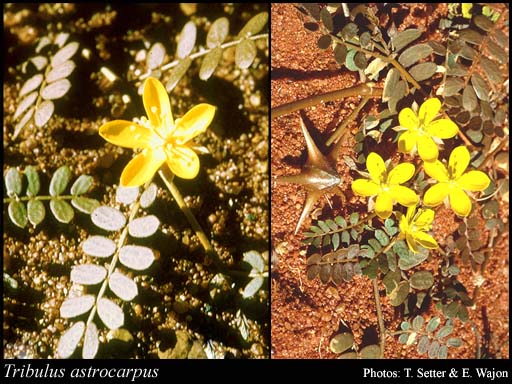
Tribulus astrocarpus F.Muell.

Reference
Fragm. (Mueller) 12:4-5 (1882)
Conservation Code
Not threatened
Naturalised Status
Native to Western Australia
Name Status
Current

Prostrate annual, herb, 0.01-0.1 m high, leaflet pairs 3-5; fruits star-shaped when viewed from above. Fl. yellow, Feb to Sep. Sandy clay loam, stony sand. River flats, drainage lines, alkaline flats.
Helen Coleman, Descriptive Catalogue, 12 November 1998
Image

Distribution

IBRA Regions
Carnarvon, Central Ranges, Gascoyne, Gibson Desert, Great Sandy Desert, Great Victoria Desert, Little Sandy Desert, Murchison, Pilbara, Yalgoo.
IBRA Subregions
Augustus, Carnegie, Chichester, Eastern Murchison, Fortescue, Hamersley, Lateritic Plain, Mackay, Mann-Musgrave Block, Rudall, Shield, Tallering, Western Murchison, Wooramel.
Local Government Areas (LGAs)
Ashburton, Carnarvon, Cue, East Pilbara, Laverton, Leonora, Meekatharra, Mount Magnet, Murchison, Ngaanyatjarraku, Sandstone, Upper Gascoyne, Wiluna, Yalgoo.