- Reference
- Mém.Mus.Hist.Nat. 3:452 (1817)
- Conservation Code
- Not threatened
- Naturalised Status
- Mixed (Native in Part of Range, Naturalised Elsewhere)
- Name Status
- Current
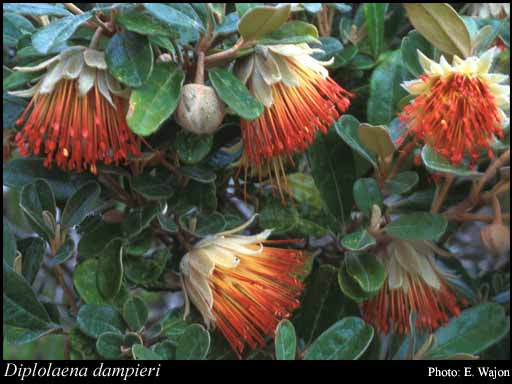
Rounded, erect, bushy shrub, 0.5-2 m high, leaves elliptic, glabrous above when mature, involucral bracts with grey indumentum. Fl. red-orange, Jul to Nov. Sand. Coastal limestone & dunes, granite rocks.
Scientific Description
Shrub, spines absent; branchlets smooth, without distinct raised glands, +/- cylindrical in cross-section, covered in hairs or scales, the hairs stellate (star-shaped). Leaves opposite, simple, 10-32 mm long, 7-11 mm wide, flat, the margins flat, smooth, without distinct raised glands, covered in hairs or scales, with stellate (star shaped) hairs; stipular excrescences absent. Flowers in a distinct head surrounded by bracts, the outer bracts 8-14 mm long; pedicels 5 mm long; calyx minute or absent, smooth, without distinct raised glands; corolla red or orange, petals five, 4-5 mm long, imbricate (overlapping), free, hairy on the margins only; stamens numerous (more than twice as many as petals), 14-20 mm long, smooth, hairy; anthers 1.8-2 mm long, without an appendage. Flowers in July, August, September, October and November. Occurs in the South-West Botanical Province, in the Jarrah Forest, Mallee and Swan Coastal Plain IBRA region(s).
Distribution
- IBRA Regions
- Jarrah Forest, Swan Coastal Plain, Warren.
- IBRA Subregions
- Perth, Southern Jarrah Forest, Warren.
- IMCRA Regions
- Leeuwin-Naturaliste.
- Local Government Areas (LGAs)
- Augusta Margaret River, Bunbury, Busselton, Capel, Cockburn, Harvey, Joondalup, Mandurah, Murray, Nannup, Rockingham.