- Reference
- Fl.Austral. 1:343 (1863)
- Conservation Code
- Not threatened
- Naturalised Status
- Native to Western Australia
- Name Status
- Current
Erect, slender or dense shrub, 0.3-2 m high, leaves linear-terete. Fl. yellow-cream-white, Jun to Oct. Mainly on gravelly lateritic soils. Lateritic hills, granite, dunes, plains.
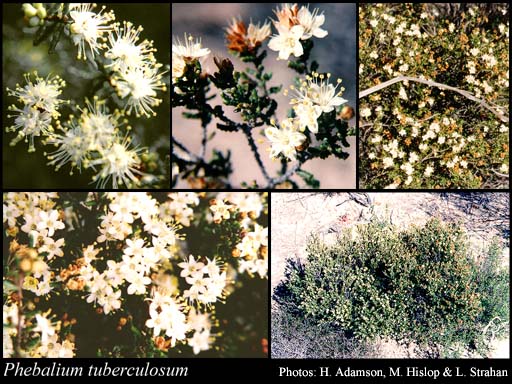
Scientific Description
Shrub, spines absent; branchlets verrucose (warty), +/- cylindrical in cross-section, glabrous. Leaves alternate, simple, 5-7 mm long, 0.8-1 mm wide, flat, the margins revolute, verrucose (warty), glabrous; stipular excrescences absent. Flowers in terminal, loose clusters (cymes or panicles); pedicels 3-4 mm long; calyx present, 2-3 mm long, verrucose (warty), covered in hairs or scales; corolla yellow or white or cream, petals five, 3-4.5 mm long, imbricate (overlapping), free, hairy on the surfaces or lepidote (with scales); stamens twice as many as petals. Flowers in June, July, August, September and October. Occurs in the Eremaean and South-West Botanical Province, in the Yalgoo, Murchison, Great Victoria Desert, Coolgardie, Jarrah Forest, Mallee, Esperance and Geraldton IBRA region(s).
Distribution
- IBRA Regions
- Avon Wheatbelt, Coolgardie, Esperance Plains, Geraldton Sandplains, Great Victoria Desert, Jarrah Forest, Mallee, Murchison, Yalgoo.
- IBRA Subregions
- Eastern Goldfield, Eastern Mallee, Eastern Murchison, Fitzgerald, Geraldton Hills, Katanning, Lesueur Sandplain, Merredin, Shield, Southern Cross, Southern Jarrah Forest, Tallering, Western Mallee.
- IMCRA Regions
- WA South Coast.
- Local Government Areas (LGAs)
- Bruce Rock, Chapman Valley, Coolgardie, Coorow, Corrigin, Dalwallinu, Dowerin, Dumbleyung, Dundas, Esperance, Gnowangerup, Goomalling, Greater Geraldton, Jerramungup, Kalgoorlie-Boulder, Katanning, Kellerberrin, Kent, Kojonup, Kondinin, Koorda, Kulin, Lake Grace, Menzies, Merredin, Moora, Morawa, Mount Marshall, Mukinbudin, Narembeen, Northampton, Nungarin, Perenjori, Pingelly, Quairading, Ravensthorpe, Tammin, Trayning, Westonia, Wickepin, Wongan-Ballidu, Woodanilling, Wyalkatchem, Yalgoo, Yilgarn.