- Reference
- Icon.Pl. 3:Tab.261-262 (1840)
- Conservation Code
- Not threatened
- Naturalised Status
- Native to Western Australia
- Name Status
- Current
Ascending perennial, herb or shrub, 0.3-1.8 m high. Fl. yellow-white, Oct to Dec or Jan to Feb. Alluvium, clay. Coastal salt marshes, estuaries & river banks, peaty swamps.
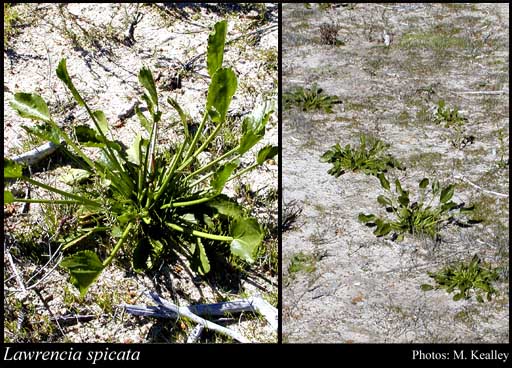
Scientific Description
Shrub, with scaly stems. Leaves 6-30 mm long, 2-10 mm wide, not lobed; margins entire; hairywith scales scales, Sessile glands absent; stipules present and persistent to older leaves. Perianth clearly of two whorls (calyx and corolla), the corolla obvious and prominent. Pedicel absent (flower sessile). Epicalyx (extra segments or 'bracteoles' immediately below the calyx) absent, indumentum present, simple hairs (without tubercle bases) absent, stellate hairs present, gland-tipped hairs absentwith scales absent. Calyx 5.5-7 mm long, the lobes fused half or more of their length, Sessile glands absent, Terminal appendages absent, number of ribs absent. Corolla yellow or white, 5.5-7 mm long, glabrous. Indumentum (outside) Sessile glands absent. Stamens many, united and arising from a staminal tube around the style; filaments present, 0.5-0.6 mm long; anthers 0.7-0.8 mm long, indumentum absent (anthers glabrous). Staminodes absent, appendages absent. Ovary hairs and scales absent (ovary quite glabrous); style 1, 4.1-5 mm long, with one or numerous style branches or lobes, mostly glabrous, wing absent. Flowering time January, February, October, November or December. Distribution Botanical Province Eremaean or South-West, IBRA Bioregion Gascoyne, Nullarbor, Geraldton Sandplains, Swan Coastal Plain, Mallee and Esperance.
Distribution
- IBRA Regions
- Avon Wheatbelt, Esperance Plains, Gascoyne, Geraldton Sandplains, Jarrah Forest, Mallee, Murchison, Nullarbor, Swan Coastal Plain, Warren.
- IBRA Subregions
- Augustus, Eastern Mallee, Eastern Murchison, Fitzgerald, Geraldton Hills, Katanning, Lesueur Sandplain, Nullarbor Plain, Perth, Recherche, Southern Jarrah Forest, Warren, Western Mallee.
- IMCRA Regions
- Central West Coast, WA South Coast.
- Local Government Areas (LGAs)
- Bunbury, Claremont, Cockburn, Coorow, Cue, Dandaragan, Esperance, Jerramungup, Kalgoorlie-Boulder, Kent, Lake Grace, Mandurah, Manjimup, Murray, Northampton, Ravensthorpe, Rockingham, Tammin, Upper Gascoyne.