- Reference
- Fragm. (Mueller) 8:242-243 (1874)
- Conservation Code
- Not threatened
- Naturalised Status
- Native to Western Australia
- Name Status
- Current
Shrub, 0.3-1.3 m high. Fl. yellow-orange, Feb or May to Sep. Sand, stony clay loam. Sandplains.
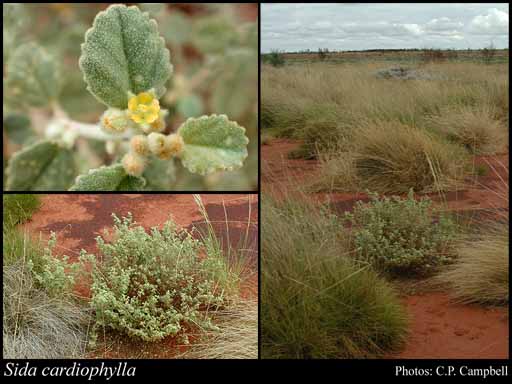
Scientific Description
Herb or shrub, with hairy stems. Leaves 10-20 mm long, 5-13 mm wide, not lobed; margins crenate; hairy, with stellate hairswith scales absent, Sessile glands absent; stipules present and persistent to older leaves or present but early deciduous (only visible on youngest leaves), 5-15 mm long. Perianth clearly of two whorls (calyx and corolla), the corolla obvious and prominent. Pedicel present, 0.5-3.5 mm long; indumentum present, with stellate hairs present, with scales absent. Epicalyx (extra segments or 'bracteoles' immediately below the calyx) absent. Calyx green, 5.5-6 mm long, the lobes fused less than half their length, Sessile glands absent, simple hairs (without tubercle bases) absent, stellate hairs present, tubercle-based simple hairs absent, gland-tipped hairs absent, scales absent, Terminal appendages absent, number of ribs absent. Corolla yellow or orange, 3 mm long, hairs or scales present, simple hairs (without tubercle bases) absent, stellate hairs present, tubercle-based simple hairs absent, gland-tipped hairs absent, scales absent. Indumentum (outside) Sessile glands absent. Stamens many, united and arising from a staminal tube around the style; filaments present, 0.2 mm long; anthers 0.8 mm long, indumentum absent (anthers glabrous). Staminodes absent, appendages absent. Ovary hairs or scales present, simple hairs absent, stellate hairs present, gland-tipped hairs absent; style 1, 2.5 mm long, with five or numerous style branches or lobes, mostly glabrous, wing absent. Flowering time February, May, June, July, August or September. Distribution Botanical Province Northern or Eremaean, IBRA Bioregion Great Sandy Desert, Pilbara, Gascoyne, Little Sandy Desert, Gibson Desert, Central Ranges, Murchison, Great Victorian Desert and Dampierland.
Distribution
- IBRA Regions
- Central Ranges, Dampierland, Gascoyne, Gibson Desert, Great Sandy Desert, Great Victoria Desert, Little Sandy Desert, Murchison, Pilbara, Tanami.
- IBRA Subregions
- Augustus, Carnegie, Central, Chichester, Eastern Murchison, Fitzroy Trough, Fortescue, Hamersley, Lateritic Plain, Mackay, Mann-Musgrave Block, McLarty, Rudall, Tanami Desert, Trainor.
- Local Government Areas (LGAs)
- Ashburton, Cue, Derby-West Kimberley, East Pilbara, Halls Creek, Laverton, Meekatharra, Ngaanyatjarraku, Port Hedland, Sandstone, Wiluna.