- Reference
- Bull.Soc.Imp.Naturalistes Moscou 19 (2):500 (1846)
- Conservation Code
- Not threatened
- Naturalised Status
- Native to Western Australia
- Name Status
- Current
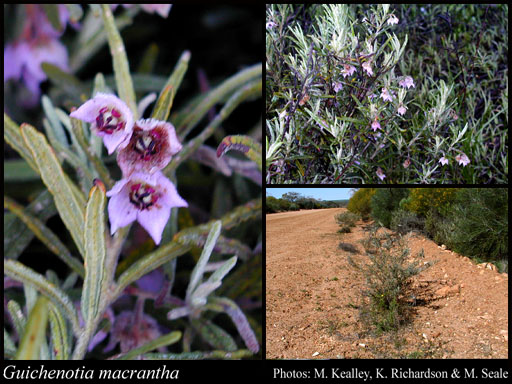
Erect, spindly or straggling shrub, 0.2-1.5 m high. Fl. blue-purple/pink, May to Sep. Sandy soils over granite or sandstone or limestone. Sandplains, lateritic breakaways, coastal cliffs, hills.
Scientific Description
Shrub, with hairy stems. Leaves 20-80 mm long, 1.5-4 mm wide, not lobed; margins entire; hairy, with stellate hairswith scales absent, Sessile glands absent; stipules present and persistent to older leaves, 26-50 mm long. Perianth of two whorls but the corolla reduced to small scales or tiny lobes at the base of the ovary. Pedicel present, 6-14 mm long; indumentum present, with stellate hairs present, with scales absent. Epicalyx (extra segments or 'bracteoles' immediately below the calyx) present, 8-13 mm long, the lobes free, indumentum present, simple hairs (without tubercle bases) absent, stellate hairs present, gland-tipped hairs absentwith scales absent, Sessile glands absent. Calyx pink, blue or purple, 15-27 mm long, the lobes fused less than half their length, Sessile glands absent, simple hairs (without tubercle bases) absent, stellate hairs present, tubercle-based simple hairs absent, gland-tipped hairs absent, scales absent, Terminal appendages absent, number of ribs present, three. Corolla 1-1.2 mm long, glabrous. Indumentum (outside) Sessile glands absent. Stamens five, free and inserted at the base of the ovary; filaments present, 3-4.2 mm long; anthers 5-6 mm long, indumentum absent (anthers glabrous). Staminodes absent, appendages absent. Ovary hairs or scales present, simple hairs absent, stellate hairs present, gland-tipped hairs absent; style 1, with a lobed or capitate stigma, 3-4.2 mm long, with one style branches or lobes, hairy for most of length, wing absent. Flowering time May, June, July, August or September. Distribution Botanical Province Eremaean or South-West, IBRA Bioregion Coolgardie, Swan Coastal Plain, Avon Wheatbelt, Jarrah Forest and Mallee.
Distribution
- IBRA Regions
- Avon Wheatbelt, Coolgardie, Geraldton Sandplains, Jarrah Forest, Mallee, Swan Coastal Plain.
- IBRA Subregions
- Geraldton Hills, Katanning, Lesueur Sandplain, Merredin, Northern Jarrah Forest, Perth, Southern Cross, Western Mallee.
- IMCRA Regions
- Central West Coast, Zuytdorp.
- Local Government Areas (LGAs)
- Bruce Rock, Carnamah, Chapman Valley, Chittering, Coorow, Corrigin, Cunderdin, Dandaragan, Dowerin, Goomalling, Greater Geraldton, Irwin, Kellerberrin, Kulin, Lake Grace, Merredin, Mingenew, Moora, Mount Marshall, Mukinbudin, Northampton, Pingelly, Quairading, Tammin, Three Springs, Victoria Plains, Westonia, Wickepin, Wongan-Ballidu.