This name is not current. Find out more information on related names.
- Reference
- Pterid.Isl.Dominica 262 (1929)
- Conservation Code
- Not threatened
- Naturalised Status
- Alien to Western Australia
- Name Status
- Not Current
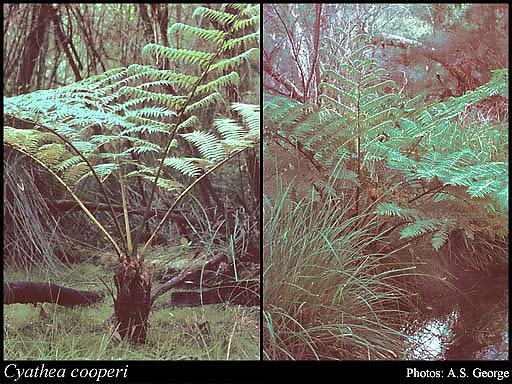
Rhizomatous, perennial, tree or herb or (tree fern), 0.5-10 m high, fronds 2-6m long; sori globular, surrounded by circular indusia of many scales. Loam, clay loam, sand. Along streams, near swamps.
Management Notes (for the Swan NRM Region)
General Biology. Reproduction. Life cycle with a sporophyte generation and a gametophyte generation. Germination from spores usually takes about three months. This species produces 22-27 fertile fronds per year.. Dispersal. Spreads by its spores, which are produced abundantly and dispersed by wind and water. Spores spread by wind can travel over 12 km from the parent plant. Seedbank persistence. Will re-shoot after fire.
Notes. The trunk, which is part of the rhizome, reaches 12 m high and up to 15 cm thick. Fronds are 3-4 m long and up to 1 m wide. Frond stalks (up to 50cm long) have whitish to pale brown basal scales (up to 50 mm long and about 5 mm wide). Leaflets are paler underneath and up to 65 cm long, consisting of pinnules up to 12 cm long and up to 2.5 cm wide. Spore cases are at the forks of veins, roundish and approximately 1 mm across..
Additional information. Origin. Native to eastern Queensland and northern New South Wales. Alien to Western Australia. History of use/introduction. Introduced for use in parks and gardens. Escaped cultivation and invaded native vegetation along streams and around swampy areas. Similar native species. Cyathea australis.
Suggested method of management and control. Larger individuals of this species can be felled, and their growing tips severed. Smaller plants are best removed entirely. Some success from spraying concentrates of dicamba and of 2,4-D directly on the stem terminals. Read the manufacturers' labels and material safety data sheets before using herbicides. For further information consult the Australian Pesticides and Veterinary Medicines Authority to determine the status of permits for your situation or state.
References
- CABI (2019) CABI. CAB International URL: https://www.cabi.org/isc/datasheet/17261 - Accessed April 2019.
- Global Invasive Species Database (2000) cyathea cooperi. Invasive Species Specialist Group. IUCN URL: http://www.iucngisd.org/gisd/species.php?sc=1183 - Accessed April 2019.
- Hawaii Invasive Species Council (2019) Australian Tree Fern. State of Hawaii URL: https://dlnr.hawaii.gov/hisc/info/invasive-species-profiles/australian-tree-fern/ - Accessed April 2019.
- PIER (2013) cyathea cooperi. Institute of Pacific Islands Forestry URL: http://www.hear.org/pier/species/cyathea_cooperi.htm - Accessed April 2019.
- Queensland Government (2016) Weeds of Australia. Identic Pty Ltd for Biosecurity Queensland URL: https://keyserver.lucidcentral.org/weeds/data/media/Html/cyathea_cooperi.htm - Accessed April 2019.