- Reference
- Gard.Dict. edn 8 (1768)
- Conservation Code
- Not threatened
- Naturalised Status
- Alien to Western Australia
- Name Status
- Current
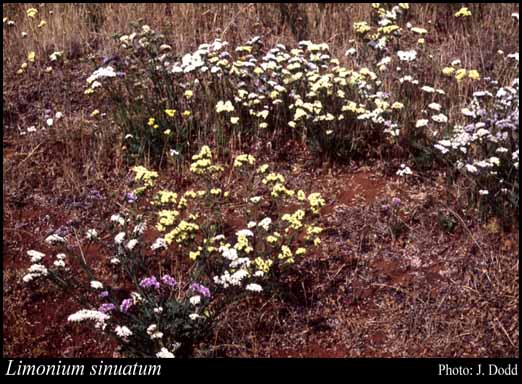
Rosetted perennial, herb, 0.15-0.6 m high. Fl. white-cream-yellow/blue, Jan or Mar to May or Sep to Dec. Disturbed areas.
Distribution
- IBRA Regions
- Avon Wheatbelt, Coolgardie, Esperance Plains, Geraldton Sandplains, Jarrah Forest, Mallee, Murchison, Swan Coastal Plain.
- IBRA Subregions
- Dandaragan Plateau, Eastern Goldfield, Eastern Murchison, Fitzgerald, Geraldton Hills, Katanning, Lesueur Sandplain, Merredin, Perth, Southern Cross, Southern Jarrah Forest, Western Mallee.
- IMCRA Regions
- Leeuwin-Naturaliste.
- Local Government Areas (LGAs)
- Albany, Augusta Margaret River, Bruce Rock, Busselton, Carnamah, Coolgardie, Coorow, Fremantle, Gingin, Gnowangerup, Goomalling, Greater Geraldton, Kulin, Lake Grace, Mandurah, Merredin, Moora, Northam, Pingelly, Ravensthorpe, Toodyay, Wagin, Wanneroo, West Arthur, Wiluna, Wongan-Ballidu, Yilgarn.
Management Notes (for the Swan NRM Region)
Alternative Names. Perennial Sea-lavender, Statice.
General Biology. Growth form. Herb. Life form. Perennial. Reproduction. Seed. Dispersal. Garden refuse, plantings.
Notes. A garden escapee, possibly a cultivar. Widespread on wasteland, roadsides and disturbed vegetation, especially on margins of saline soils.
Additional information. Origin. Europe, western Asia, northern Africa. History of use/introduction. Ornamental, particularly cut flowers.
Suggested method of management and control. Hand remove small infestations. Read the manufacturers' labels and material safety data sheets before using herbicides. For further information consult the Australian Pesticides and Veterinary Medicines Authority to determine the status of permits for your situation or state.
Management Calendar
| Calendar Type | Jan | Feb | Mar | Apr | May | Jun | Jul | Aug | Sep | Oct | Nov | Dec | Comments |
|---|---|---|---|---|---|---|---|---|---|---|---|---|---|
| Germination | U | U | U | U | |||||||||
| Active Growth | Y | Y | Y | Y | Y | ||||||||
| Flowering | Y | Y | Y | Y | Y | Y | Y | Y | Y | ||||
| Fruiting | Y | Y | Y | Y | Y | Y | Y | Y | |||||
| Manual Removal | Y | Y | Y | Y | Y | Y | Y | Y | Y | Y | Y | Y |
Legend: Y = Yes, regularly, O = Occasionally, U = Uncertain, referred by others but not confirmed.
References
- Brown, K. & Brooks, K. (2002) Bushland Weeds: A Practical Guide to their Management. Environmental Weeds Action Network, Greenwood.
- Hussey, B.M.J., Keighery, G.J., Dodd, J., Lloyd, S.G. & Cousens, R.D. (2007) Western Weeds. A guide to the weeds of Western Australia. 2nd Edition. The Plant Protection Society of Western Australia, Victoria Park.
- USDA, ARS, National Genetic Resources Program (2009) Germplasm Resources Information Network - (GRIN). National Germplasm Resources Laboratory, Beltsville, Maryland. URL: https://npgsweb.ars-grin.gov/gringlobal/taxon/taxonomysimple.aspx - Accessed October 2009.