
Service Notice

The Western Australian Herbarium’s collections management system, WAHerb, and DBCA’s flora taxonomic names application, WACensus, have been set to read-only mode since 1 October 2025. Recent taxonomic changes are not currently being reflected in Florabase, herbarium collections, or the census. Due to the rapidly approaching holiday season and associated agency and facility soft closures, along with the substantial work involved in data mapping, cleaning, and verification, the migration to the new collection management software is not expected to occur before 1 March 2026, when a further update will be provided. Please reach out to us if you have any questions or concerns.

The notice period started at 9:45 am on Friday, 12 December 2025 +08:00 and will end at 12:00 pm on Monday, 2 March 2026 +08:00.

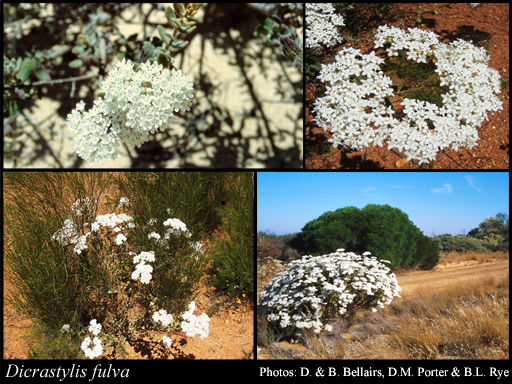
Dicrastylis fulva Harv.

Reference
Hooker's J.Bot.Kew Gard.Misc. 7:56 (1855)
Conservation Code
Not threatened
Naturalised Status
Native to Western Australia
Name Status
Current

Bushy shrub, (0.3-)0.5-1(-1.5) m high, stem indumentum of non-glandular, patent dentritic hairs 0.4-1.4 mm long; leaves 5-14 mm wide. Fl. white, Aug to Dec. Red, yellow or white sand, sandy clay or loam. Plains.
Helen Coleman, Descriptive Catalogue, 13 November 1998
Image

Distribution

IBRA Regions
Avon Wheatbelt, Geraldton Sandplains, Murchison, Yalgoo.
IBRA Subregions
Eastern Murchison, Edel, Geraldton Hills, Merredin, Tallering.
Local Government Areas (LGAs)
Chapman Valley, Dalwallinu, Greater Geraldton, Morawa, Mount Magnet, Northampton, Sandstone, Shark Bay, Yalgoo.