- Reference
- Proc.Linn.Soc.New South Wales 92:210 (1968)
- Conservation Code
- Not threatened
- Naturalised Status
- Native to Western Australia
- Name Status
- Current
Compact, dense shrub, 0.2-0.7 m high, leaves with revolute margins and stellate hairs below. Fl. pink-blue-purple, Aug to Nov. Sand, clay, often gravelly soils. Stony slopes, undulating plains.
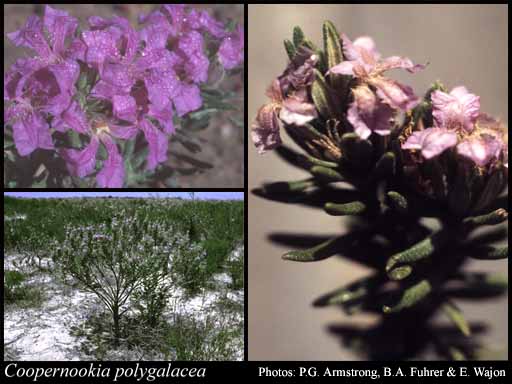
Scientific Description
Stems unribbed. Leaves flat, 10-25 mm long, 2-9 mm wide, Indumentum present, with dense, simple hairs; margins entire. Bracteoles absent. Pedicel absent (flowers sessile). Calyx lobes present, Calyx length 3-4 mm long, hairy, with dense, stellate hairs. Corolla blue, mauve or purple, 11-17 mm long, without auricles, not spurred, hairy on the outside, with dense, stellate hairs, hairy on the inside; central lobes 4.5-7.5 mm long, with wings; outer lobes 5-10 mm long, wings present on both sides, 1.3-1.5 mm wide. Anthers free. Ovary inferior, not gibbose; style 7-9 mm long, hairy; indusium single, hairy; ovules one or two. Flowers in August, September, October and November. Occurs in the Jarrah Forest (JF), Mallee (MAL) and Esperance Plains (ESP) IBRA Region(s).
Distribution
- IBRA Regions
- Coolgardie, Esperance Plains, Jarrah Forest, Mallee.
- IBRA Subregions
- Eastern Mallee, Fitzgerald, Recherche, Southern Cross, Southern Jarrah Forest, Western Mallee.
- IMCRA Regions
- WA South Coast.
- Local Government Areas (LGAs)
- Albany, Cranbrook, Dumbleyung, Esperance, Gnowangerup, Jerramungup, Kent, Plantagenet, Ravensthorpe, Yilgarn.