- Reference
- Fl.Austral. 4:118 (1868)
- Conservation Code
- Priority Three
- Naturalised Status
- Native to Western Australia
- Name Status
- Current
Erect, slender perennial, herb, 0.05-0.3(-0.6) m high, stems with blunt angles. Fl. blue, May or Aug to Dec. Sand, sometimes with gravel. Plains.
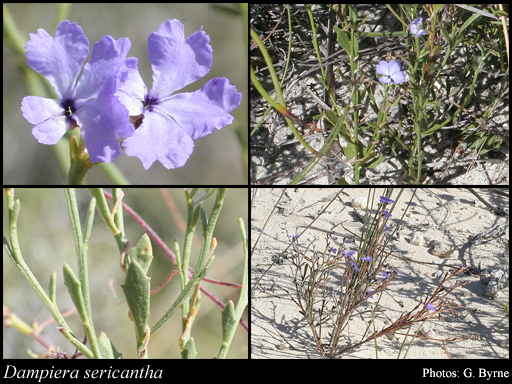
Scientific Description
Stems ribbed. Leaves flat, 10-20 mm long, 2-5 mm wide, Indumentum absent (leaves glabrous); margins toothed. Bracteoles present, 2-3 mm long, hairy, with simple hairs. Pedicel pedicellate, Pedicel length the pedicels 5-10 mm long, Indumentum present, Hair type with absent hairs. Calyx lobes present, Calyx length 0.4 mm long, hairy, with sparse, simple hairs. Corolla blue, 7-12 mm long, auriculate, not spurred, hairy on the outside, with dense, simple hairs, glabrous on the inside; central lobes 2.7-5.5 mm long, with wings; outer lobes 4-5.5 mm long, wing present on both sides and clearly unequal, 0.2-0.4 mm wide on the narrower side, 0.5-1 mm wide on the broader side. Anthers connate. Ovary inferior, not gibbose; style 2-3.5 mm long, glabrous; indusium single, glabrous; ovules one or two. Flowers in May and August. Occurs in the Jarrah Forest (JF) and Esperance Plains (ESP) IBRA Region(s), of the South West (SW) Botanical Province. Conservation Code: Conservation code Priority Three (P3).
Distribution
- IBRA Regions
- Esperance Plains, Mallee.
- IBRA Subregions
- Eastern Mallee, Fitzgerald, Recherche.
- Local Government Areas (LGAs)
- Esperance, Ravensthorpe.