- Reference
- Trans.& Proc.Roy.Soc.South Australia 36:172 (1912)
- Conservation Code
- Not threatened
- Naturalised Status
- Native to Western Australia
- Name Status
- Current
Herb, to 0.5 m high. Fl. yellow, probably Jan to Dec. Red loam, sand.
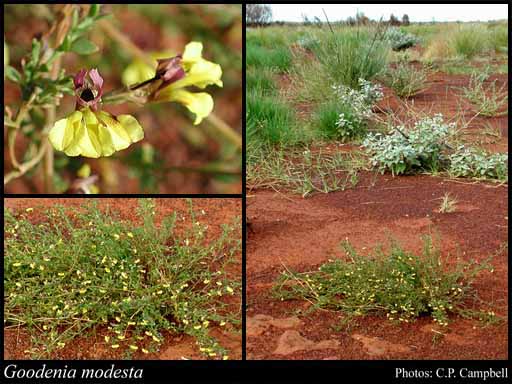
Scientific Description
Stems unribbed. Leaves flat, 7-70 mm long, 2-10 mm wide, Indumentum present, with sparse, simple hairs; margins entire. Bracteoles present, 2.2-3.5 mm long, hairy, with simple hairs. Pedicel pedicellate, Pedicel length the pedicels 7-10 mm long, Indumentum present, Hair type with simple hairs. Calyx lobes present, Calyx length 3-6 mm long, hairy, with sparse, simple hairs. Corolla yellow, 8-17 mm long, auriculate, not spurred, hairy on the outside, with sparse, simple hairs, hairy on the inside; central lobes 2.5-5 mm long, with wings; outer lobes 4-8 mm long, wing present on both sides and clearly unequal, 0.7-1 mm wide on the narrower side, 1.5-2 mm wide on the broader side. Anthers free. Ovary inferior, not gibbose; style 4-7 mm long, hairy; indusium single, hairy; ovules more than two. Flowers in January, February, March, April, May, June, July, August, September, October, November and December. Occurs in the Central Ranges (CR), Gibson Desert (GD), Great Sandy Desert (GSD), Little Sandy Desert(LSD) and Tanami (TAN) IBRA Region(s), of the Eremaean (E) Botanical Province. Conservation Code: Conservation code Priority Three (P3).
Distribution
- IBRA Regions
- Central Ranges, Gascoyne, Gibson Desert, Great Sandy Desert, Great Victoria Desert, Little Sandy Desert, Murchison, Pilbara, Tanami.
- IBRA Subregions
- Augustus, Carnegie, Central, Dune Field, Eastern Murchison, Hamersley, Lateritic Plain, Mackay, Mann-Musgrave Block, Tanami Desert, Trainor.
- Local Government Areas (LGAs)
- Ashburton, East Pilbara, Halls Creek, Laverton, Leonora, Meekatharra, Ngaanyatjarraku, Wiluna.