- Reference
- Fragm. (Mueller) 2:20 (1860)
- Conservation Code
-
Threatened
A taxon name retains its ‘Threatened’ status until a new name has been officially endorsed and appears in the Gazettal Notice.
- Naturalised Status
- Native to Western Australia
- Name Status
- Current
Diffuse, ascending, much-branched shrub, to 0.3 m high. Fl. blue-green-yellow, Aug to Sep. Rocky sandstone gullies & on ledges.
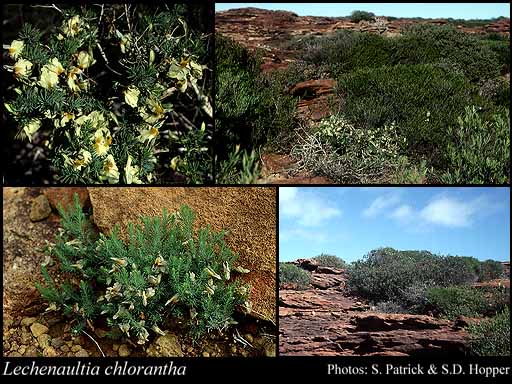
Scientific Description
Stems unribbed. Leaves flat, 3-15 mm long, 0.3-0.5 mm wide, Indumentum absent (leaves glabrous); margins entire. Bracteoles absent. Pedicel pedicellate, Pedicel length the pedicels 7-8 mm long, glabrous. Calyx lobes present, Calyx length 7-10 mm long, glabrous. Corolla blue or orange, 19-23 mm long, without auricles, not spurred, glabrous on the outside, glabrous on the inside, with wings, 2.5-3 mm wide. Anthers free. Ovary inferior, not gibbose; style 17-18 mm long, glabrous; indusium single, hairy; ovules more than two. Flowers in August and September. Occurs in the Geraldton Sandplains (GS) IBRA Region(s), of the South West (SW) Botanical Province. Conservation Code: Conservation code Threatened (T).
Distribution
- IBRA Regions
- Geraldton Sandplains.
- IBRA Subregions
- Geraldton Hills.
- IMCRA Regions
- Central West Coast.
- Local Government Areas (LGAs)
- Northampton.