- Reference
- Freyc., Voy.Uranie [Freycinet] 460 (1829)
- Conservation Code
- Not threatened
- Naturalised Status
- Native to Western Australia
- Name Status
- Current
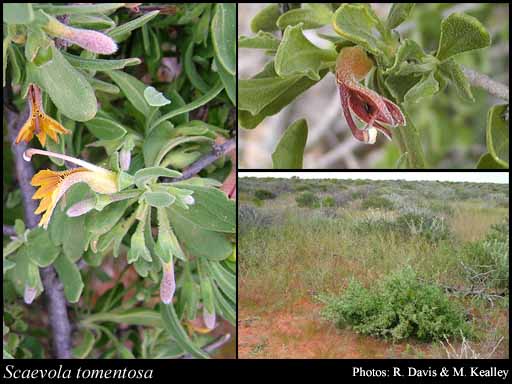
Divaricate shrub, 0.2-2 m high, with dense, stellate indumentum. Fl. yellow/orange-brown-red, May to Oct. Sandy soils, limestone. Sand dunes, coastal plains.
Scientific Description
Stems unribbed. Leaves flat, 15-50 mm long, 7-10 mm wide, Indumentum present, with dense, stellate hairs; margins toothed. Bracteoles absent. Pedicel pedicellate, Pedicel length the pedicels 7-10 mm long, Indumentum present, Hair type with stellate hairs. Calyx lobes present, Calyx length 3-8 mm long, hairy, with dense, stellate hairs. Corolla red or orange, 20-27 mm long, without auricles, not spurred, hairy on the outside, with dense, stellate hairs, hairy on the inside; central lobes 4.5-5 mm long, with wings; outer lobes 4.5-7 mm long, wing present on both sides and clearly unequal, 0.4-0.5 mm wide on the narrower side, 0.6-0.7 mm wide on the broader side. Anthers free. Ovary inferior, not gibbose; style 24-25 mm long, hairy; indusium single, hairy; ovules one or two. Flowers in May, June, July, August, September and October. Occurs in the Murchison (MUR), Carnarvon (CAR) and Geraldton Sandplains (GS) IBRA Region(s), of the Eremaean (E) and South West (SW) Botanical Province.
Distribution
- IBRA Regions
- Avon Wheatbelt, Carnarvon, Gascoyne, Geraldton Sandplains, Murchison, Yalgoo.
- IBRA Subregions
- Cape Range, Carnegie, Eastern Murchison, Edel, Geraldton Hills, Merredin, Tallering, Western Murchison, Wooramel.
- IMCRA Regions
- Central West Coast, Pilbara (nearshore), Shark Bay, Zuytdorp.
- Local Government Areas (LGAs)
- Carnarvon, Chapman Valley, Cue, Exmouth, Greater Geraldton, Meekatharra, Mingenew, Morawa, Murchison, Northampton, Shark Bay, Wiluna, Yalgoo.