
Service Notice

The Western Australian Herbarium’s collections management system, WAHerb, and DBCA’s flora taxonomic names application, WACensus, have been set to read-only mode since 1 October 2025. Recent taxonomic changes are not currently being reflected in Florabase, herbarium collections, or the census. Due to the rapidly approaching holiday season and associated agency and facility soft closures, along with the substantial work involved in data mapping, cleaning, and verification, the migration to the new collection management software is not expected to occur before 1 March 2026, when a further update will be provided. Please reach out to us if you have any questions or concerns.

The notice period started at 9:45 am on Friday, 12 December 2025 +08:00 and will end at 12:00 pm on Monday, 2 March 2026 +08:00.

Calocephalus knappii (F.Muell.) Ewart & Jean White

Reference
Proc.Roy.Soc.Victoria 22:319 (1910)
Conservation Code
Not threatened
Naturalised Status
Native to Western Australia
Name Status
Current

Decumbent to ascending annual, herb, to 0.2 m high. Fl. yellow, Jul to Oct. Red sandy soils, sandy clay. Hardpan plains, near drainage channels.
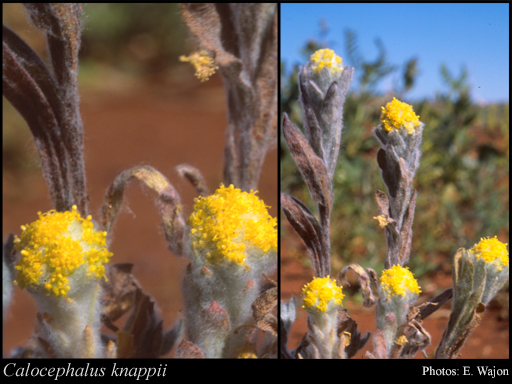
Amanda Spooner, Descriptive Catalogue, 23 April 1997
Image

Distribution

IBRA Regions
Carnarvon, Central Ranges, Gascoyne, Gibson Desert, Great Sandy Desert, Great Victoria Desert, Little Sandy Desert, Murchison, Nullarbor, Pilbara.
IBRA Subregions
Ashburton, Augustus, Cape Range, Carlisle, Central, Chichester, Eastern Murchison, Fortescue, Hamersley, Lateritic Plain, Mackay, Mann-Musgrave Block, Rudall, Trainor, Western Murchison, Wooramel.
Local Government Areas (LGAs)
Ashburton, Carnarvon, Cue, East Pilbara, Exmouth, Laverton, Leonora, Meekatharra, Menzies, Murchison, Ngaanyatjarraku, Port Hedland, Sandstone, Upper Gascoyne, Wiluna, Yalgoo.