- Reference
- Descr.Icon.Rar.Pl. 39 (1773)
- Conservation Code
- Not threatened
- Naturalised Status
- Mixed (Native in Part of Range, Naturalised Elsewhere)
- Name Status
- Current
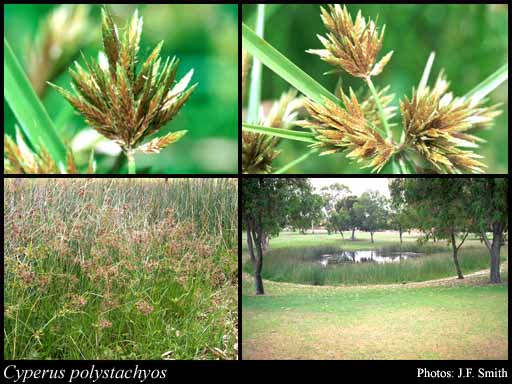
Shortly rhizomatous, perennial or annual, grass-like or herb (sedge), 0.15-0.6 m high. Fl. green-brown, Dec or Jan to Feb or Apr to Jul. White or wet black sand. In disturbed damp areas.
Distribution
- IBRA Regions
- Dampierland, Darwin Coastal, Geraldton Sandplains, Indian Tropical Islands, Jarrah Forest, Northern Kimberley, Ord Victoria Plain, Pilbara, Swan Coastal Plain, Victoria Bonaparte.
- IBRA Subregions
- Dandaragan Plateau, Geraldton Hills, Hamersley, Keep, Lesueur Sandplain, Mitchell, Northern Jarrah Forest, Perth, Pindanland, Purnululu, Roebourne.
- IMCRA Regions
- Pilbara (nearshore).
- Local Government Areas (LGAs)
- Ashburton, Bayswater, Broome, Canning, Chittering, Christmas Island, Gingin, Gosnells, Halls Creek, Harvey, Karratha, Kwinana, Melville, Mundaring, Murray, Northampton, Port Hedland, South Perth, Stirling, Subiaco, Swan, Three Springs, Wanneroo, West Arthur, Wyndham-East Kimberley.
Management Notes (for the Swan NRM Region)
Alternative Names. Many-spike Flatsedge, Field Sedge.
General Biology. Growth form. Sedge. Life form. Perennial. Reproduction. Seed. Dispersal. Water, soil.
Additional information. Origin. Eastern Australia, cosmpolitan origin.
Suggested method of management and control. Try 1% glyphosate + Pulse®. Read the manufacturers' labels and material safety data sheets before using herbicides. For further information consult the Australian Pesticides and Veterinary Medicines Authority to determine the status of permits for your situation or state.
Management Calendar
| Calendar Type | Jan | Feb | Mar | Apr | May | Jun | Jul | Aug | Sep | Oct | Nov | Dec | Comments |
|---|---|---|---|---|---|---|---|---|---|---|---|---|---|
| Germination | |||||||||||||
| Active Growth | Y | Y | Y | Y | Y | Y | Y | O | Y | Y | |||
| Flowering | Y | Y | Y | Y | Y | Y | Y | Y | |||||
| Fruiting | Y | Y | Y | Y | Y | ||||||||
| Manual Removal | Y | Y | Y | Y | Y | Y | Y | Y | Y | Y | Y | Y | |
| Herbicide Treatment | O | O | O | O | O | O | O | Y | Y |
Legend: Y = Yes, regularly, O = Occasionally, U = Uncertain, referred by others but not confirmed.
References
- Brown, K. & Brooks, K. (2002) Bushland Weeds: A Practical Guide to their Management. Environmental Weeds Action Network, Greenwood.
- Hussey, B.M.J., Keighery, G.J., Dodd, J., Lloyd, S.G. & Cousens, R.D. (2007) Western Weeds. A guide to the weeds of Western Australia. 2nd Edition. The Plant Protection Society of Western Australia, Victoria Park.
- Moore, C.B. & Moore, J.H. (2002) Herbiguide, the pesticide expert on a disk. Herbiguide, PO Box 44 Albany, Western Australia, 6330.
- USDA, ARS, National Genetic Resources Program (2009) Germplasm Resources Information Network - (GRIN). National Germplasm Resources Laboratory, Beltsville, Maryland. URL: https://npgsweb.ars-grin.gov/gringlobal/taxon/taxonomysimple.aspx - Accessed October 2009.