Wurmbea drummondii Benth.
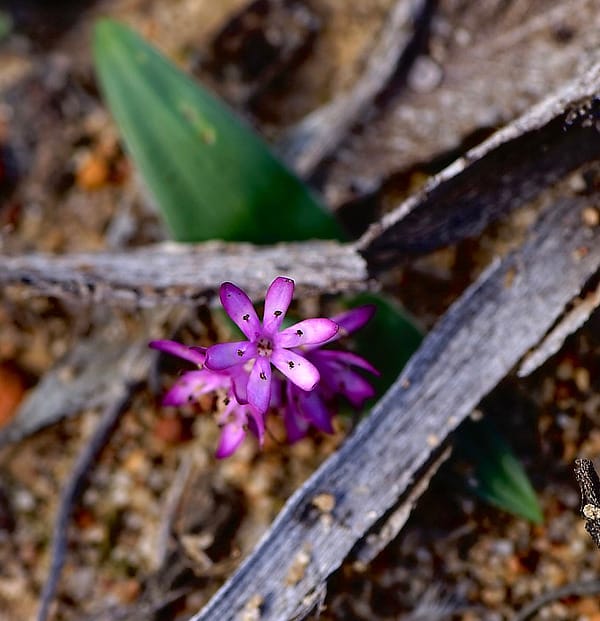
Sometimes tiny plants need time to shine in the spotlight! One such minuscule flower that can be found flowering in June is the York Gum Nancy (Wurmbea drummondii). This species is an Australian representative of the family Colchicaceae, all of which are corm-forming plants that shoot up in the winter months, flower, fruit and then die back to the corm to escape the summer heat. Wurmbea drummondii is a small species that grows to around 5 cm in height, bearing three leaves: two broad basal leaves and a third leaf held midway up the inflorescence. The broader basal leaves are rather unusual, for many Wurmbea tend to have more grass-like leaves. Flowers of York Gum Nancy are usually white to pinkish, on comparatively many-flowered inflorescences, and are usually dioecious.
York Gum Nancy was once thought to have a smaller distribution within the wheatbelt, but has subsequently been found to be more widespread. It can be found growing from Carnamah to Dumbleyung, in the Wheatbelt region, where it is usually found in clay or loamy soils in eucalyptus woodlands or areas that are seasonally wet.
Photo: R. Craig