
Service Notice

The Western Australian Herbarium’s collections management system and census were set to read-only mode on 1 October 2025. Taxonomic updates published since this time are not being reflected in Florabase, herbarium collections, or Western Australia’s taxonomic names census (Nomos). Conservation listings displayed on Florabase may also be out of date. Please refer to DBCA’s Threatened species and communities webpage for the most recent Threatened and Priority Flora List, noting that recent taxonomic updates are similarly not included. Our database migration is moving to a staging phase. We thank you for your patience as we ensure the integrity of our biodiversity data, develop new workflows, and train staff to use the new systems. Please reach out to us if you have any questions or concerns.

The notice period started at 12:00 pm on Wednesday, 1 October 2025 +08:00 and will end at 12:00 pm on Friday, 1 January 2027 +08:00.

Plant of the Month
March 2026

POTM

Caulerpa cactoides (Turner) C.Agardh
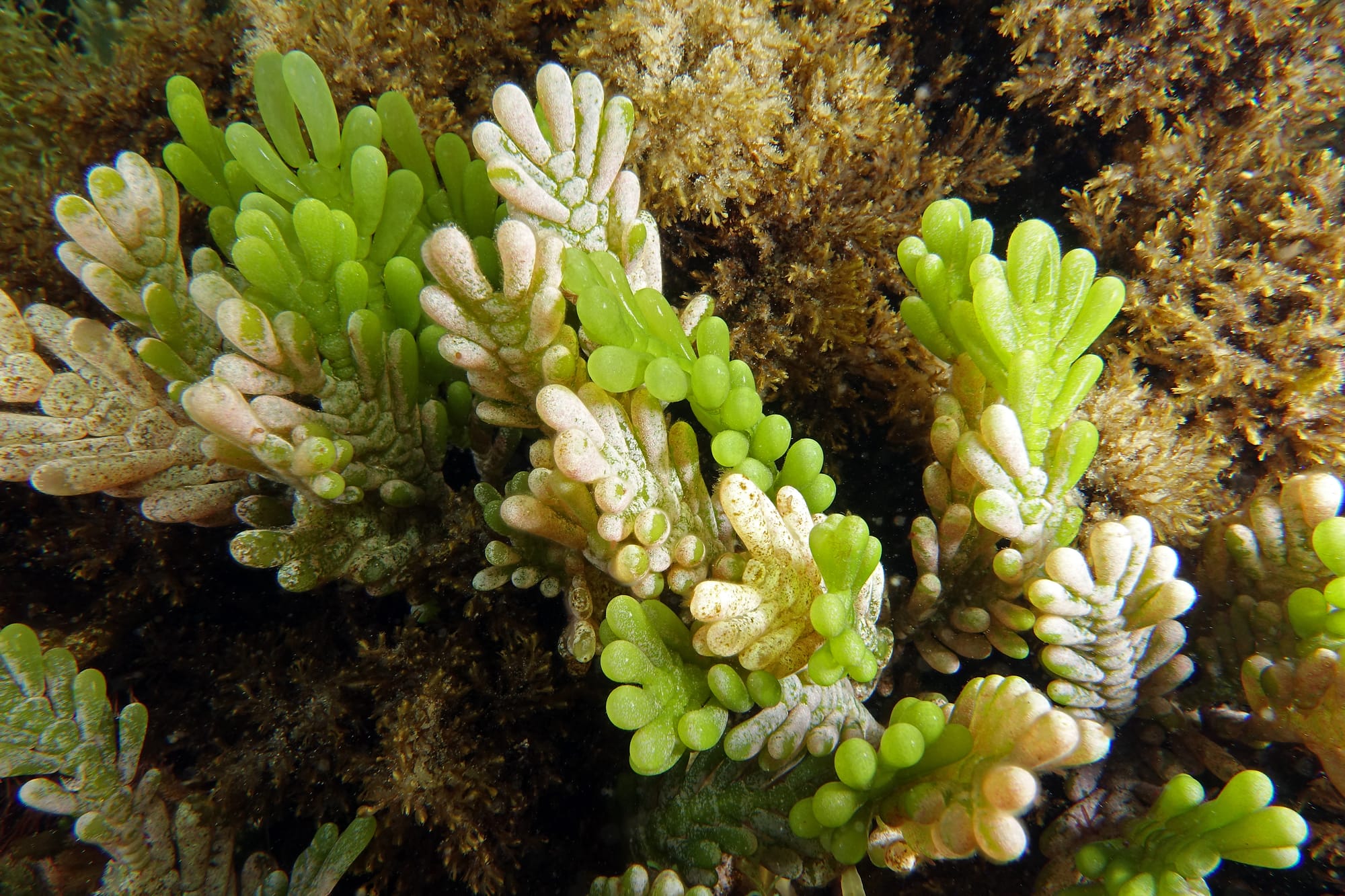
Sea cactus (Caulerpa cactoides) is one of numerous species of the seaweed genus Caulerpa, which is found on all coasts but is most diverse in southern Australia. All species have one distinctive feature in common: a horizontal stem, called a ‘stolon’, that grows across the sea floor (the genus name is Greek for ‘creeping stem’). The upright fronds of Caulerpa come in a myriad of forms. In C. cactoides, they are thick and resemble a cactus, but in other species, they can be spiny or grape-like. The pale pink coating seen on this specimen from Cape Peron is a crustose coralline alga, which does not appear to negatively impact the Caulerpa.

Sea cactus is widely distributed across southern Australia, extending north along the west coast as far as Barrow Island. It can grow in a wide range of environments, from very shallow waters to depths of 30 metres or more, on both sheltered and rough water coasts.

Photo: J. Huisman

Find out more about Caulerpa cactoides (Turner) C.Agardh