Tubifera ferruginosa (Batsch) J.F.Gmel.
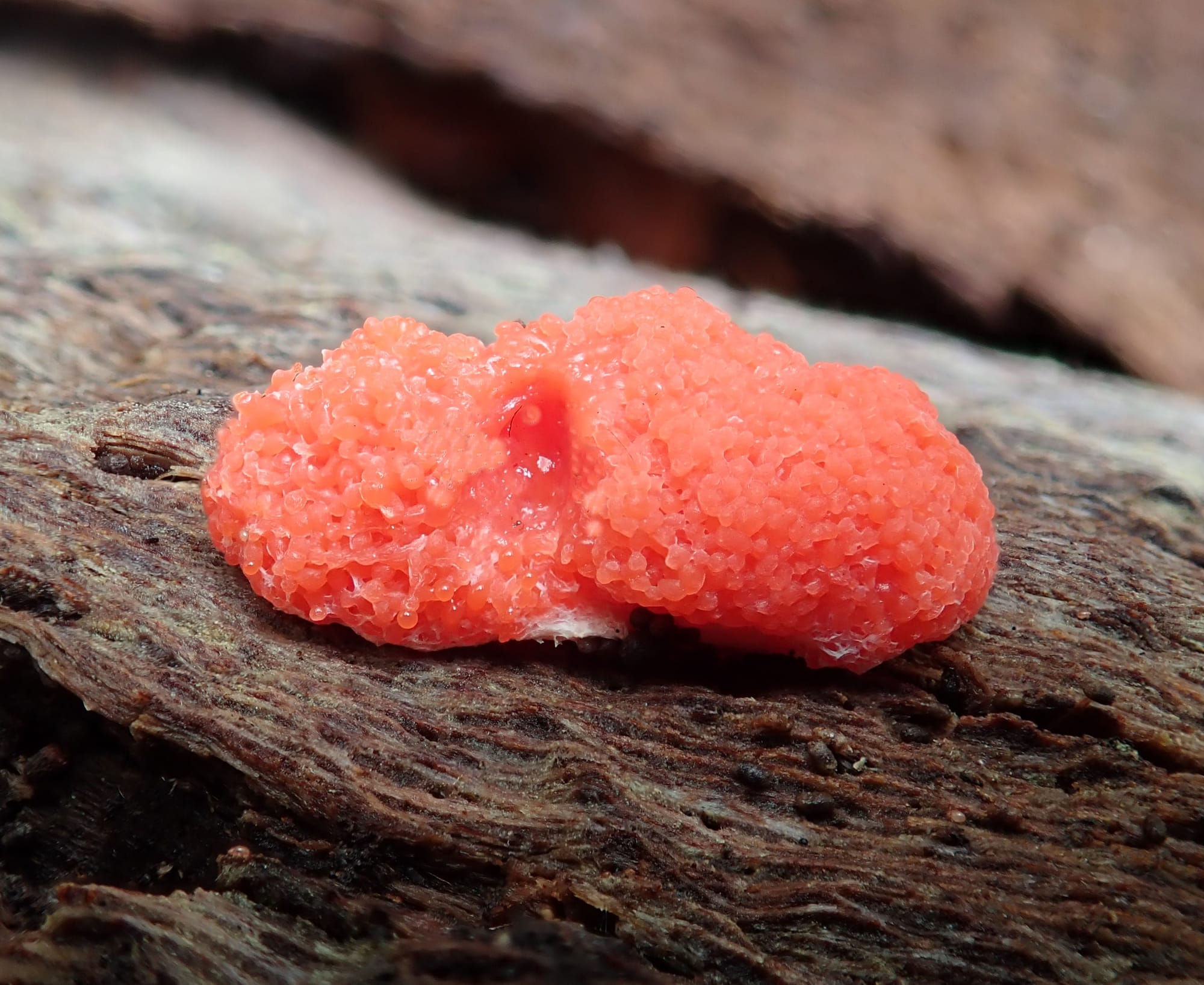
As we get closer to Djilba and spring, it’s the perfect time to get down and take a closer look at slime moulds. The Red Raspberry Slime Mould (Tubifera ferruginosa) is one of many species you may find out and about on rotting wood, bark or amongst the leaf litter. It is an easily recognised species because of its relatively large and brightly coloured bleb stage of development, hence its common name. The bleb stage is the transition between the feeding plasmodium (slime) and the mature pseudoaethalium filled with mature spores. As the bleb matures, it turns a brownish colour and is usually quite difficult to find as it will be camouflaged against the substrate. These slime moulds occur as a single pseudoaethalium up to a relatively large grouping, each one pillow-shaped, 5–20 mm across, with a somewhat rounded and intricate top surface. A pseudoaethalium is a compound fruiting of many individuals that fuse to look like one individual, which the mature top surface reveals.
This species occurs on rotting wood or thick bark, often on Banksia species, in seasonally wet periods in the south-west and Kimberley regions. Recent studies suggest this species may not occur in Australia, and work is ongoing to determine which species we may have here.
Photo: K. Knight