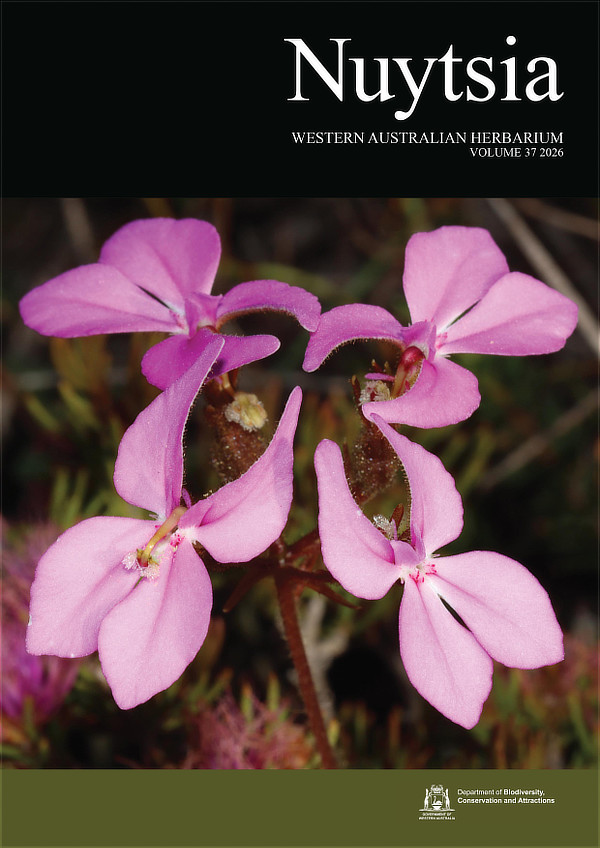
Tetratheca exasperata and T. phoenix (Elaeocarpaceae), two new conservation-listed species allied to T. setigera, from south-west Western Australia
BUTCHER, R.
The two new species described here are similar to Tetratheca setigera Endl. in having the upper part of the pedicel, the receptacle and the calyx segments densely ornamented with long, red, glandular setae. Tetratheca exasperata R.Butcher differs most readily from T. setigera in its almost glabrous leaves, with strongly revolute margins, and very short, patent stem hairs. This taxon has been infrequently collected from three areas in the Jarrah Forest and Avon Wheatbelt regions and has a Priority Three conservation listing. Tetratheca phoenix R.Butcher differs from T. setigera in its almost glabrous, but prominently tuberculate, stems and densely glandular-hairy ovary. This taxon is restricted to Mt Cooke, c. 70 km south-east of Perth and has a Priority Two conservation listing. These two new species are described and illustrated here, and their distributions are mapped.