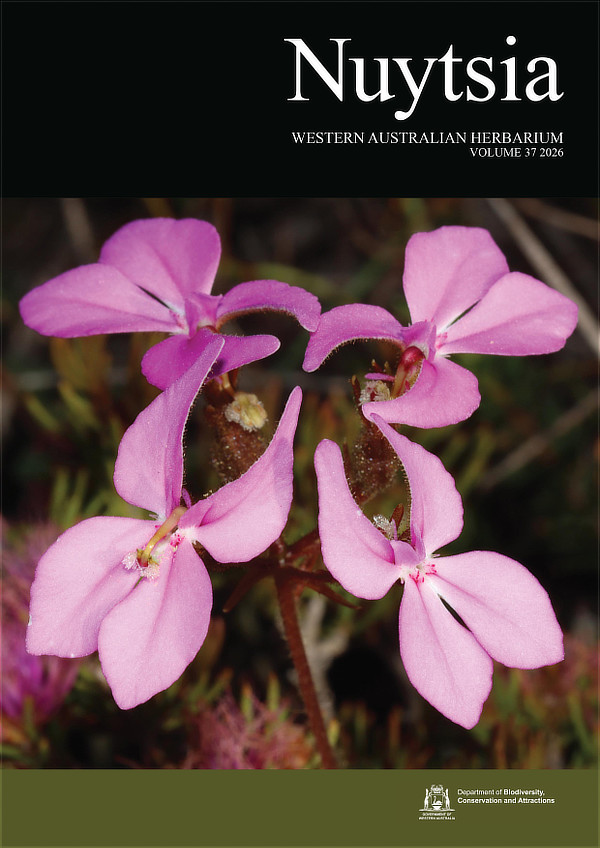
Taxonomic research and the conservation status of flora in the Yilgarn Banded Iron Formation ranges
GIBSON, N., COATES, D.J. AND THIELE, K.R.
The Banded Iron Formation (BIF) ranges are small, ancient ranges scattered across the Yilgarn Craton in southern Western Australia. Increased exploration and mining of iron ore in Western Australia has resulted in a resurgence of botanical survey on and around the BIF ranges, including the discovery of at least 20 unnamed taxa, nine of which were new to science. Recent taxonomic work, published in this special edition of Nuytsia, has concentrated on naming 17 taxa with distributions centred on these ranges and a further 62 taxa of conservation significance in the southern half of Western Australia. Despite this increase in activity, the conservation status of the flora and vegetation remains poorly documented. Patterns in distribution of threatened, rare and poorly known taxa (Declared Rare Flora and Priority Flora) and patterns in endemism are examined on a subset of the 25 ranges most prospective for mining. Preliminary analysis of endemism supports the hypotheses that these ranges represent both refugial habitats of great antiquity and areas of recent speciation. Across Western Australia there are some 2,240 taxa under consideration for formal listing by the Department of Environment and Conservation as threatened; of these, 475 are yet to be formally named. This situation significantly impedes their conservation assessment.