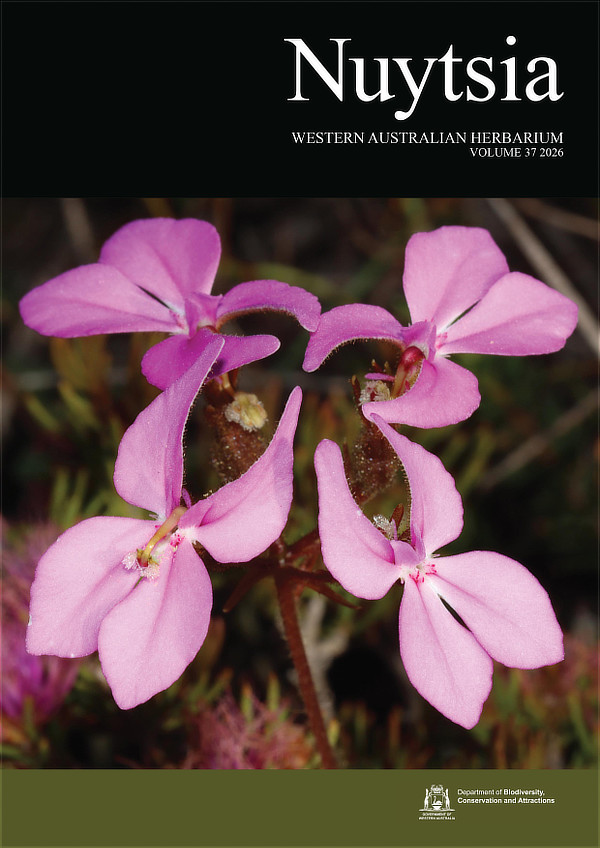
Stackhousia stratfordii (Celastraceae: Stackhousioideae), a remarkable new species from a remote location near Norseman, south-west Western Australia
BARKER, W.R. AND COCKERTON, G.T.B.
Stackhousia stratfordii W.R.Barker & Cockerton sp. nov. possesses attributes unique to its genus and subfamily of opposite sub-radical leaves and flowers borne in scapes and containing three stamens. Morphological evidence is summarised arguing its placement within Stackhousia . The Stackhousioideae Burnett are a subfamily distinctive in Celastraceae R.Br. for their herbaceous life-form, mainly moth-pollinated, tubular flowers, and fruits that are single-seeded indehiscent mericarps (cocci) (Barker 1983, 1984, in press); in terms of diversity they are centred in Australia, occurring in much of the continent, in temperate arid, semi-arid and sub-tropical regions. Until recently a separate family (Stackhousiaceae R.Br.), the subfamily has morphological and geographic features unique in the family Celastraceae, in which they have been placed in the last decade (Kubitzki 2004a, b; Simmons 2004 a, b). It comprises three genera: Tripterococcus Endl. with three species , confined to south-west Western Australia, Macgregoria F.Muell., a single species spread across the southern half of arid Australia, and Stackhousia Sm. with over 30 species spread over the geographical and climatic range of the subfamily in Australia, with a single species in New Zealand and another spread into Malesia, the Philippines and Micronesia (Barker, in press).