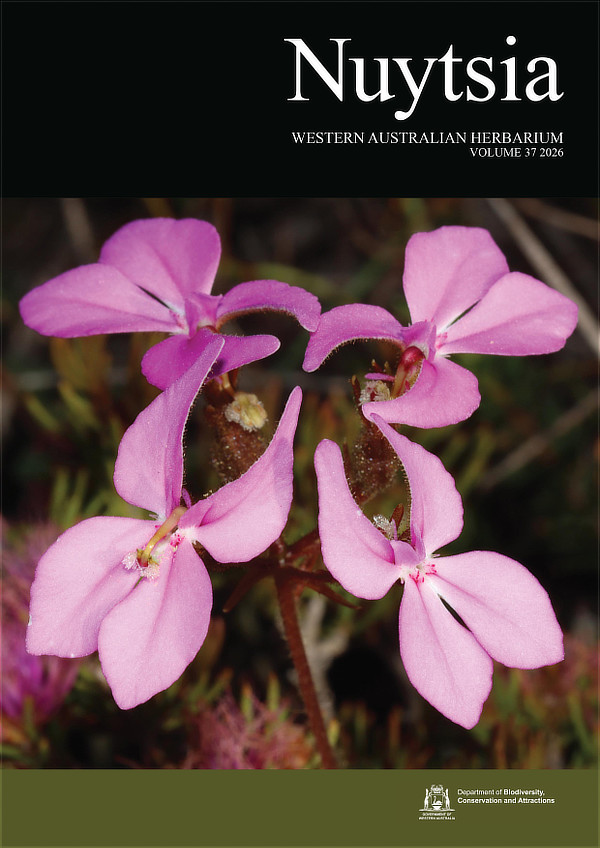
A taxonomic revision of the Stylidium brunonianum alliance (sect. Saxifragoidea: Stylidiaceae)
WEGE, J.A.
A morphological assessment of Stylidium brunonianum Benth. and its allies recognises eight taxa, all of which are endemic to the south-west of Western Australia. Following examination of type material and field work, a narrower circumscription of S. brunonianum is presented, S. tenue Sond. is reinstated and the following five taxa are newly described: S. araeophyllum Wege, S. neurophyllum Wege, S. purpureum Wege, S. spiciforme Wege and S. tenue subsp. majusculum Wege. A revised description is provided for S. lowrieanum Carlquist, a conservation-listed species from the Leeuwen-Naturaliste Ridge. Lectotypes are selected for S. brunonianum, S. tenue and S. brunonianum var. minor Benth., with the varietal name newly placed into synonymy under S. tenue. A lectotype is also designated for the name S. striatum Lindl. var. glaucum Benth. (based on collections of S. lowrieanum, S. neurophyllum, S. bellum Wege and S. rosulatum Wege) to fix its application as a synonym of S. rosulatum. A dichotomous key to the S. brunonianum alliance is provided along with photographs of key features and distribution maps.