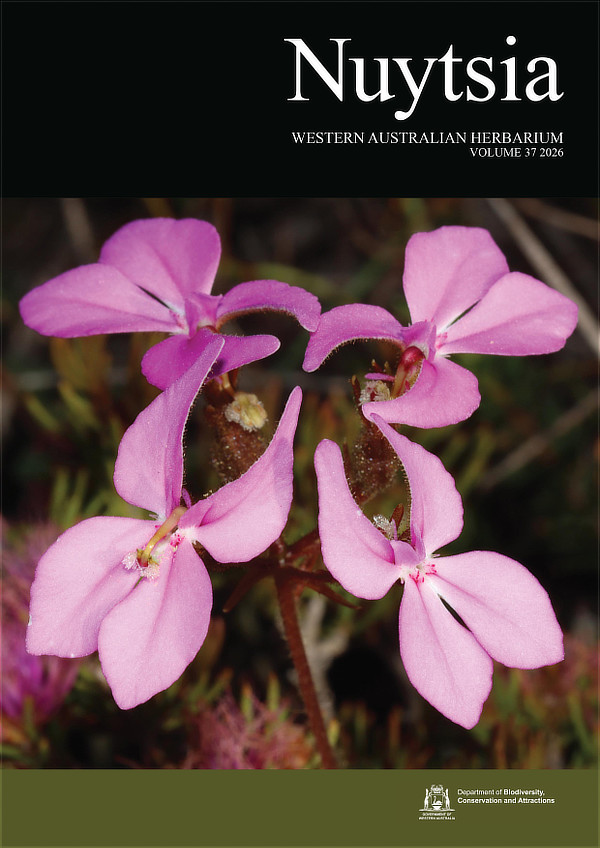
The Western Australian Herbarium’s collections management system, WAHerb, and DBCA’s flora taxonomic names application, WACensus, have been set to read-only mode since 1 October 2025. Recent taxonomic changes are not currently being reflected in Florabase, herbarium collections, or the census. The project team is now conducting testing of the migrated data, and a further update will be provided by the end of the financial year (1 July). Please reach out to us if you have any questions or concerns.
The notice period
started at 9:45 am on Friday, 12 December 2025 +08:00 and will end at 12:00 pm on Wednesday, 1 July 2026 +08:00.
Tecticornia papillata K.A.Sheph., described here as new, has an unusual fruit structure previously only observed in T. disarticulata (Paul G.Wilson) K.A.Sheph. & Paul G.Wilson. It differs from this species in having vegetative articles and bracts with strongly fimbriate margins and caudate apices, and a distinctly papillate epidermis for which the species is named. As this new species has a restricted distribution it has a Priority One conservation status. A distribution map and images of the species are presented. In addition, the molecular and morphological diversity within T. disarticulata is discussed.
New combinations in the genus Dysphania (Chenopodiaceae)
SHEPHERD, K.A. AND WILSON, PAUL G., Nuytsia18: 267–272 (2008)
A long standing recognition of a possible affinity between Dysphania R.Br. and Chenopodium L. subg. Ambrosia A.J.Scott has been corroborated by molecular phylogenetic evidence. While the North American species of C. subg. Ambrosia have been transferred to Dysphania this has not occurred elsewhere. In light of this, new combinations are made here for the Australian and New Zealand species of C. subg. Ambrosia. A key to the Australian species of Dysphania is provided.
Pilostyles coccoidea (Apodanthaceae), a new species from Western Australia described from morphological and molecular evidence
THIELE, K.R.,WYLIE, S.J.,MACCARONE, L. AND HOLLICK, P., Nuytsia18: 273–284 (2008)
Pilostyles coccoidea K.R.Thiele, a new species of holoparasitic flowering plant found on the legume genus Jacksonia R.Br. ex Sm., is described and illustrated. The new species is related to P. collina Dell and P. hamiltonii C.A.Gardner, both also from south-western Western Australia but growing on different hosts. The three species differ in morphological features of flowers and fruits. In addition, analysis of nad1, 16S and matR gene sequences confirms the distinctness of P. coccoidea from P. hamiltonii. Pilostyles coccoidea appears to be a relatively common species within its restricted range of distribution between Eneabba and the Moore River, north of Perth.
Stylidium perplexum (Stylidiaceae): a remarkable new triggerplant from south-west Western Australia
Stylidium perplexum Wege is newly described and photographs and a distribution map provided. This distinctive triggerplant has a tuberous, multi-stemmed and somewhat shrubby habit, discoid glandular trichomes restricted to the pedicels and hypanthia, linear leaves to 2 cm long, an elliptic hypanthium, narrow calyx lobes, and white to purplish laterally-paired corolla lobes bearing eight purple-tipped throat appendages. It occurs within a Conservation Park south-east of Dardanup and is listed as having conservation priority in Western Australia.
A new subspecies of Gnaphalium indutum (Asteraceae: Gnaphalieae)
Gnaphalium indutum Hook.f. is considered to consist of two infraspecific taxa, subsp. indutum and subsp. acuminatum Paul G.Wilson subsp. nov. The latter is predominantly an inland taxon of non-saline habitats.
Coronidium, a new Australian genus in the Gnaphalieae (Asteraceae)
The genus Coronidium Paul G.Wilson, a segregate of Helichrysum Mill. sensu lato, is described. It consists of 17 species, all of which are found in eastern Australia while two are also present in South Australia and one in Tasmania. Six species and two subspecies are described as new: C. cymosum Paul G.Wilson, C. elatum (A.Cunn. ex DC.) Paul G.Wilson subsp. minus Paul G.Wilson, C. elatum subsp. vellerosum Paul G.Wilson, C. flavum Paul G.Wilson, C. fulvidum Paul G.Wilson, C. lanosum Paul G.Wilson, C. kaputaricum Paul G.Wilson, and C. telfordii Paul G.Wilson, while Helichrysum adenophorum var. waddelliae J.H.Willis is raised to species rank as C. waddelliae (J.H.Willis) Paul G.Wilson; a further ten species are transfers from Helichrysum: C. oxylepis (F.Muell.) Paul G.Wilson, C. rupicola (DC.) Paul G.Wilson, C. glutinosum (Hook.) Paul G.Wilson, C. lanuginosum (A.Cunn. ex DC.) Paul G.Wilson, C. newcastlianum (Domin) Paul G.Wilson, C. boormanii (Maiden & Betche) Paul G.Wilson, C. elatum (DC.) Paul G.Wilson, C. lindsayanum (Domin) Paul G.Wilson, C. adenophorum (F.Muell.) Paul G Wilson, and C. scorpioides (Labill.) Paul G.Wilson. Several names are lectotypified.
Notes on the genus _Chrysocephalum (_Angianthinae: Asteraceae) with the description of one new species from Western Australia, and a new combination
The probability of the genus Chrysocephalum being paraphyletic is reviewed. Helichrysum gilesii F.Muell. is transferred to Chrysocephalum. A new species from the Gibson Desert, Western Australia is described and is compared with its close relative C. gilesii (F.Muell.) Paul G.Wilson. A widespread taxon from southern Australia which has been variously referred to as Chrysocephalum apiculatum (Labill.) Steetz or C. aff. apiculatum is shown to be C. vitellinum Sond.; this name is lectotypified. A key to the species of Chrysocephalum found in Western Australia is provided.
Lepidosperma amansiferrum is an orthographic error of L. amantiferrum
The name Lepidosperma amansiferrum R.L.Barrett was recently published for a new species restricted to banded ironstone formations in the southern Goldfields of Western Australia (Barrett 2007). Karen Wilson and Peter Wilson (both Royal Botanic Gardens Sydney) recently drew my attention to an error in the way the Latin words were combined to form this name. Constructed from the Latin words amans (loving) and ferrum (iron), the word amans, when combined with ferrum, should be declined to amanti- (Stearn 1992).
Kennedia lateritia, a new name for Kennedia macrophylla (Fabaceae)
LALLY, T.R. AND WILSON, PAUL G., Nuytsia18: 340–341 (2008)
The plant currently referred to as Kennedia macrophylla (Meisn.) Benth. is a twining or scrambling shrub with a very restricted distribution in the far south-west of Western Australia. It is listed as Declared Rare Flora under the Western Australian Wildlife Conservation Act 1950 and is endangered under the Commonwealth Environment Protection and Biodiversity Conservation Act 1999 (DEWHA 2007). In contrast to its rarity in nature, this taxon is widely cultivated in temperate Australia (Jones & Gray 1977; Elliot & Jones 1993). In view of the horticultural and conservation significance of this species, a necessary change to its nomenclature is presented here in advance of a revision of the subtribe Kennediinae currently in preparation by the first author.
Calytrix gomphrenoides (Myrtaceae), a new species from the Kimberley Region of Western Australia
BARRETT, M.D.,CRAVEN, L.A. AND BARRETT, R.L., Nuytsia19 (1): 1–8 (2009)
Calytrix gomphrenoides M.D.Barrett & Craven is described as a new species from sandstone pavements of the north-west Kimberley Region of Western Australia. It is apparently most closely related to C. inopinata Craven in the C. exstipulata DC. alliance. Emendations to a published key and notes on related species are provided.
Tetratheca plumosa (Elaeocarpaceae), a new species closely allied to Tetratheca similis from south-west Western Australia
Tetratheca plumosa R.Butcher sp. nov., was was collected from private property near New Norcia in 2007 and confirmed to be a new species in 2008. This species is closely allied to T. similis Joy Thomps., but differs significantly in having elongate, plumose, gland-tipped hairs on the ovary. Tetratheca plumosa is described herein and its affinities discussed. Illustrations and a distribution map are provided.
The taxonomy of Leucopogonbossiaea and allied species (Ericaceae: Styphelioideae: Styphelieae) from the central south coast of Western Australia
Four new species of Leucopogon R.Br., L. canaliculatus Hislop,L. heterophyllus Hislop, L. remotus Hislop and L. rugulosus Hislop, are described, illustrated and their distributions mapped.For purposes of comparison, a full description of their closest named relative, L.bossiaea (F.Muell.) Benth., is also given. A key is provided to all of the Western Australian species currently referred to the informal subgeneric group,the Leucopogon australis Group (sensu Hislop & Chapman (2007), to which the new species belong.
Six new and rare species of Darwinia (Myrtaceae) from Western Australia
Darwinia chapmaniana Keighery, D. foetida Keighery, D. ferricola Keighery, D. nubigena Keighery, D. polychroma Keighery and D. whicherensis Keighery are newly described. All of these species are endemic in south-west Western Australia and are considered endangered under the Western Australian Wildlife Conservation Act .
New taxa of Ptilotus (Amaranthaceae) from Western Australia
Two new species, Ptilotus daphne Lally and P. rigidus Lally, and a new subspecies of P. polakii, subsp. juxtus Lally are described, with distribution maps and illustrations provided.
Three new species of Acacia (Leguminosae: Mimosoideae) from the Kimberley Region, Western Australia
LEWINGTON, M.A. AND MASLIN, B.R., Nuytsia19 (1): 63–75 (2009)
Three new species of Acacia Mill. endemic to the Kimberley region of northern Western Australia are described: Acaciabarrettiorum Lewington & Maslin sp. nov., A. spectra Lewington & Maslin sp. nov., A. spectra Lewington & Maslin _sp. nov._and A. willingii Lewington & Maslin sp. nov.Acacia willingii is listed as Priority One and A.barrettiorum and A.spectra as Priority Two species under the Department of Environment and Conservation’s Conservation Codes for Western Australian flora.
Four new obligate seeder taxa of Eucalyptus series Rufispermae (Myrtaceae) from the transitional rainfall zone of south-western Australia
Three new species are described, viz. E. vittata D.Nicolle, an obligate seeder previously confused with the respouter species E. sheathiana Maiden and also differing from the latter in the narrower adult leaves and smaller buds and fruits_; E. frenchiana _ D.Nicolle_,_ an obligate seeder from between Norseman and Hyden, previously confused with E. corrugata Luehm. but most closely related to E. pterocarpa C.A.Gardner ex P.J.Lang and differing from the latter in the smaller leaves, buds and fruits and the hemispherical opercula; and E. distuberosa D.Nicolle_,_ an obligate seeder previously confused with the respouter species E. pileata Blakely_._ Two subspecies are recognized in E. distuberosa, viz. subsp. distuberosa, of widespread but scattered distribution in the southern goldfields, and subsp. aerata D.Nicolle, restricted to Bronzite Ridge west of Norseman. A key to the obligate seeder taxa of E. ser_._ Rufispermae Maiden is provided.
Eucalyptuscalycogona subsp. miracula (Myrtaceae), a new subspecies from the central wheatbelt of Western Australia
NICOLLE, D. AND FRENCH, M.E., Nuytsia19 (1): 99–105 (2009)
A new subspecies of Eucalyptus calycogona Turcz.is described, differing from the other three subspecies of E. calycogona by the waxy branchlets, buds and fruits, the generally broader, dull adult leaves which are bluish at least when new, the consistently elliptical to ovate seedling leaves, and the generally larger flower buds and fruits. The new ubspecies is distributed on the eastern edge of the central wheatbelt in Western Australia, to the north-west of the distribution of subsp. calycogona. A key to E. ser_. Heterostemones_ Benth., a map indicating the distribution of E. calycogona in Western Australia, and illustration of the holotype and habit of E. calycogona subsp. miracula D.Nicolle & M.E.French are included.
A conspectus of the genus Amaranthus (Amaranthaceae) in Australia
A synopsis of the 26 Amaranthus species known to occur in Australia is presented. Amaranthus centralis J.Palmer & Mowatt and A. induratus C.A.Gardner ex J.Palmer & Mowatt are described as new; distribution maps and photographs of the type specimens are included for these new species. Amaranthus undulatus R.Br. is the earliest correct name for the taxon currently known as A. pallidiflorus F.Muell., and lectotypes are selected for A. clementii Domin, A. leptostachyus Benth., A. macrocarpus Benth. and A. mitchellii Benth. A key to all species in Australia is presented.
A reduced circumscription of Balaustion and description of the new genus Cheyniana (Myrtaceae: Chamelaucieae)
The myrtaceous genus Balaustion Hook. is reduced to its original monotypic circumscription. Balaustion s. str. is closely related to Tilophloia Trudgen & Rye ms., both genera having stamens in a single circular series, broad filaments, a very large placenta and seeds with a large concave hilum, but Balaustion is distinguished by its prostrate habit with adventitious roots, basifixed anthers and long tubular flowers adapted to pollination by birds. A second bird-pollinated species with elongated flowers, previously known as B. microphyllum C.A.Gardner, is transferred into the new genus Cheyniana Rye as C. microphylla (C.A.Gardner) Rye. Since the type material of this species is missing, it is lectotypified on the original illustration. Another large-flowered species, but with more spreading, apparently insect-pollinated flowers, is described as C. rhodella Rye & Trudgen. Cheyniana is related to also Oxymyrrhine Schauer, which it resembles in its very reduced anthers and narrow filaments, but differs in its large colourful petals and woody indehiscent fruit. Both of the small genera treated in this taxonomic revision belong to the tribe Chamelaucieae and are restricted to the south-west of Western Australia.
Reinstatement of the Western Australian genus Oxymyrrhine (Myrtaceae: Chamelaucieae) with three new species
The south-western Australian genus Oxymyrrhine Schauer is reinstated and the type species, previously known as Baeckea polyandra F. Muell., is restored to its earlier name of O. gracilis Schauer.A lectotype is selected for B. polyandra and three new species, Oxymyrrhinecordata Rye & Trudgen, O. coronata Rye & ; Trudgen and O. plicata Rye & Trudgen_,_ are described. These four species make up a group described here as Oxymyrrhines. str. and are distinguished from other members of Oxymyrrhine s. lat. and from all other genera of tribe Chamelaucieae by the broad cavity in the summit of their fruit. Oxymyrrhine s. lat. includes a particularly difficult species complex, which will be revised at a later time.