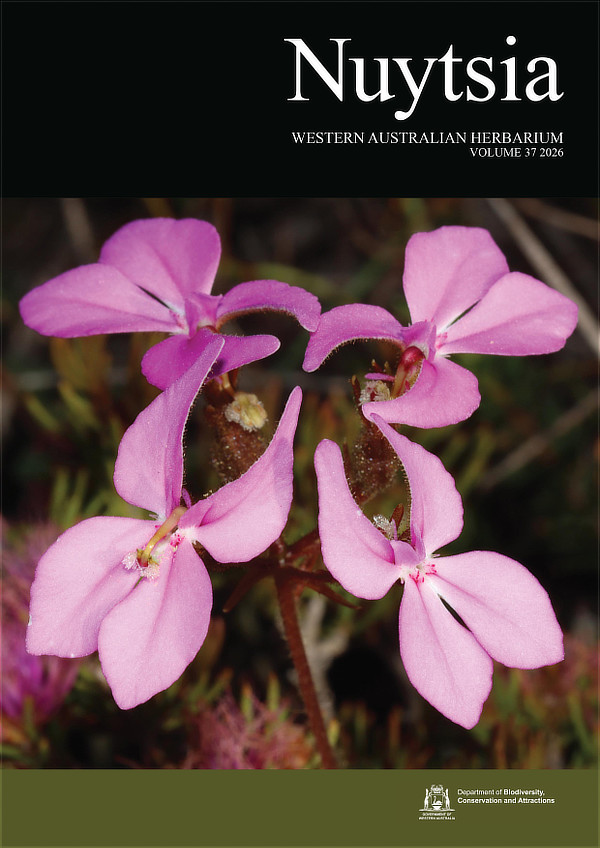
The Western Australian Herbarium’s collections management system, WAHerb, and DBCA’s flora taxonomic names application, WACensus, have been set to read-only mode since 1 October 2025. Recent taxonomic changes are not currently being reflected in Florabase, herbarium collections, or the census. The project team is now conducting testing of the migrated data, and a further update will be provided by the end of the financial year (1 July). Please reach out to us if you have any questions or concerns.
The notice period
started at 9:45 am on Friday, 12 December 2025 +08:00 and will end at 12:00 pm on Wednesday, 1 July 2026 +08:00.
In this partial revision of Xerochrysum Tzvelev the following taxa are described as new: X. alpinum Paul G.Wilson, X. boreale Paul G.Wilson, X. halmaturorum Paul G.Wilson and X. interiore Paul G.Wilson. Accounts of several published and unpublished species from north-east New South Wales and south-east Queensland that are currently recognised are omitted since these are being studied by other botanists; however, these taxa are included in the key to species provided here. Lectotypes are chosen for Helichrysum bracteatum var. viscosum DC., X. bicolor (Lindl.) R.J.Bayer and X. viscosum (Sieber ex Spreng.) R.J.Bayer.
An expanded circumscription and new infrageneric classification of Rinzia (Myrtaceae: Chamelaucieae)
The circumscription of Rinzia Schauer (Myrtaceae tribe Chamelaucieae DC.) is enlarged to encompass species with varied stamen arrangement, filament width and seed morphology. This revision of Rinzia s. lat. is based on both morphological and molecular evidence, and establishes five sections within the genus, Discolora Rye, Mesostemon Rye, Polyandra Rye, Semasperma Rye and the typical section. All sections occur in Western Australia, with three of them endemic to the south-west, while sect. Polyandra also occurs in central Australia and sect. Semasperma also occurs in south-eastern Australia. Three new combinations are made for species previously included within Baeckea L., and the new name R. orientalis Rye is published for B. crassifolia Lindl. Baeckea crassifolia var. icosandra F.Muell. ex Benth. is raised to species rank as R. icosandra (F.Muell. ex Benth.) Rye. The other new combinations are R. ericaea (F.Muell. ex Benth.) Rye and R. polystemonea (F.Muell.) Rye. Four new Western Australian species are described as R. fimbriolata Rye & Trudgen, R. medifila Rye, R. torquata Rye & Trudgen and R. triplex Rye & Trudgen, and a new subspecies from Kangaroo Island, South Australia, as R. ericaea subsp. _insularis_Rye. Rinzia morrisonii Trudgen is reduced to synonymy under R. longifolia Turcz. Lectotypes are selected for Baeckea ericaea F.Muell. ex Benth. and R. morrisonii. Seven Western Australian species have conservation priority.
Five new species of Styphelia (Ericaceae: Epacridoideae: Stypheliae) from the Geraldton Sandplains, including notes on a new, expanded circumscription for the genus
HISLOP, M. AND PUENTE-LELIÈVRE, C., Nuytsia28: 95–114 (2017)
Five new species of Styphelia Sm. (S. ciliosa Hislop & Puente-Lel., S. filamentosa Hislop & Puente-Lel., S. filifolia Hislop & Puente-Lel., S. longissima Hislop & Puente-Lel. and S. williamsiorum Hislop & Puente-Lel.) are described, illustrated and mapped. All were previously recognised by phrase names under Leucopogon R.Br., and occur in the Lesueur Sandplain subregion of the Geraldton Sandplains bioregion. There is discussion of the recent decision to greatly expand the circumscription of Styphelia to include the genera Coleanthera Stschegl., Croninia J.M.Powell, most species of Astroloma R.Br. and a large percentage of those previously treated as Leucopogon.
Taxonomic notes on Asterolasia (Rutaceae) in Western Australia to inform conservation
Following examination of collections at the Western Australian Herbarium, the Threatened species Asterolasia nivea (Paul G.Wilson) Paul G.Wilson is synonymised under A. grandiflora (Hook.) Benth. A revised description is provided for A. grandiflora, a geographically restricted species that will remain listed as Priority Four under Department of Parks and Wildlife Conservation Codes for Western Australian Flora despite its expanded circumscription. Asterolasia pallida Benth. subsp. hyalina Paul G.Wilson, a distinctive taxon previously only known from Dryandra State Forest, is raised to species level and A. sp. Kalgan River (S. Barrett 1522), which is listed as Threatened in Western Australia, is treated as synonymous. While the latter action greatly expands the known range of A. hyalina (Paul G.Wilson) Wege, this taxon retains its conservation ranking of Priority Two. A key to species of Asterolasia F.Muell. in Western Australia is provided.
Acacia nicholsonensis (Fabaceae), a new ‘Minni Ritchi’-barked species of Acacia sect. Juliflorae from the Gulf of Carpentaria region of Northern Australia
CUFF, N.J. AND COWIE, I.D., Nuytsia28: 147–158 (2017)
Acacia nicholsonensis Cuff is described as a new species of Acacia Mill. sect. Juliflorae (Benth.) Maiden & Betche. Acacia nicholsonensis is currently only known from the upper Nicholson River catchment in the far east of the Northern Territory where it is restricted to the levees and banks of major river channels. A key to the ‘Minni Ritchi’-barked Acacia species of the Top End of the Northern Territory and adjacent regions of tropical northern Australia is presented. The conservation status and ecology of the new species are discussed.
New lectotypes and synonyms in the Western Australian genus Scholtzia (Myrtaceae: Chamelaucieae)
Lectotypes are selected for the genus Scholtzia Schauer and for S. capitata F.Muell. ex Benth., S. leptantha Benth., S. oligandra F.Muell. ex Benth., S. parviflora F.Muell. and Baeckea obovata DC. Scholtzia obovata (DC.) Schauer is reinstated and S. leptantha reduced to a synonym of it. Two informal names are made redundant by the lectotypifications. Brief descriptions are provided for these taxa as now defined.
A revision of the Hibbertia lineata (Dilleniaceae) species group
The Hibbertia lineata Steud. species group comprises six species endemic in south-western Western Australia. Hibbertia lineata is recircumscribed to include H. recurvifolia (Steud.) Benth., and H. polyancistra K.R.Thiele sp. nov., H. depilipes K.R.Thiele sp. nov., H. verrucosa (Turcz.) Benth., H. microphylla Steud. and H. papillata J.R.Wheeler are described and discussed. A key is provided to all taxa.
Neotypification and redescription of Amanita preissii (Basidiomycota), and reconsideration of the status of A. griseibrunnea
Amanita preissii (Fr.) Sacc. is redescribed. Re-examination of collections of A. griseibrunnea O.K.Mill. show that they do not differ significantly from A. preissii and the two species are combined. This species is common in the Perth IBRA subregion. Sequence data from the nuclear ribosomal internal transcribed spacer (ITS) region, 28S nuclear ribosomal large subunit rRNA (28S) region, RNA polymerase II (RPB2) region, β-tubulin region and translation elongation factor 1-α (EF1-α) region have been deposited in GenBank.
Revision of the south-western Australian genus Anticoryne (Myrtaceae: Chamelaucieae)
Anticoryne Turcz. comprises three species occurring in a relatively small portion of south-western Australia. Stamen morphology is of diagnostic importance for the genus, as is its very dark seed colour. In this revision of the genus, the new species A. melanosperma Rye is named and a lectotype is selected for A. ovalifolia (F.Muell.) Rye. All species have conservation priority.
Calandrinia holtumii (Portulacaceae), a new and unusual species from arid Western Australia
OBBENS, F.J.,HANCOCK, L.P.,EDWARDS, E. AND THIELE, K.R., Nuytsia28: 217–223 (2017)
A new species of Calandrinia Kunth., C. holtumii Obbens & L.P.Hancock, from arid Western Australia is described and mapped. At this stage, the sectional placement for C. holtumii is uncertain. It has several anomalous morphological characters not previously recorded within the genus and has recently been shown to exhibit a stronger form of Crassulacean Acid Metabolism (CAM) than any other Australian species of Calandrinia.
Stylidium miscellany 3: a synopsis of Robert Brown’s Stylidiaceae types and occasional notes on associated names
A synopsis of the 39 species of Stylidiaceae named by Robert Brown is presented and a full synonymy provided. Lectotypes are selected for the following Brown names: Levenhookia pusilla R.Br., Stylidium alsinoides R.Br., S. articulatum R.Br., S. assimile R.Br., S. caespitosum R.Br., S. calcaratum R.Br., S. corymbosum R.Br., S. crassifolium R.Br., S. diversifolium R.Br., S. eriorhizum R.Br., S. fasciculatum R.Br., S. floribundum R.Br., S. guttatum R.Br., S. tenuifolium R.Br. (= S. laricifolium Rich.), S. luteum R.Br., S. pedunculatum R.Br., S. reduplicatum R.Br. (= S. pilosum (Labill.) Labill.), S. spinulosum R.Br., S. tenellum R.Br. (= S. tenerum Spreng.) and S. violaceum R.Br. Stylidium robustum Sond. is newly synonymised under S. diversifolium and lectotypes are selected for two additional synonyms of this species, S. marginatum Sond. and S. pruinosum Sond. Stylidium pilosum is lectotypified and a neotype designated for S. pilosum var. brevius E.Pritz. Comments on the uncertain circumscription of S. armeria (Labill.) Labill. (of which S. melastachys R.Br. is a synonym) are provided.
Hibbertia striata, a new combination for a long-overlooked Western Australian species, and inclusion of H. pachyrrhiza in H. huegelii
The common and widespread species Hibbertia huegelii (Endl.) F.Muell. comprises two distinct taxa, one of which matches the type of Candollea striata Steud., which is here recombined as Hibbertia striata (Steud.) K.R.Thiele. Hibbertia pachyrrhiza Steud. is reduced to a synonym of H. huegelii s. str. Descriptions and distribution maps are provided for both accepted species.
Nomenclatural changes in Chenopodium (incl. Rhagodia) (Chenopodiaceae), with considerations on relationships of some Australian taxa and their possible Eurasian relatives
MOSYAKIN, S.L. AND IAMONICO, D., Nuytsia28: 255–271 (2017)
Following recent molecular phylogenetic results, species earlier placed in Rhagodia R.Br. were transferred to Chenopodium L. (Chenopodiaceae). However, three new species-level combinations proposed were later homonyms and thus illegitimate under ICN Art. 53.1. The new name C. wilsonii S.Fuentes, Borsch & Uotila [= C. crassifolium (R.Br.) S.Fuentes & Borsch, comb. illeg.] has been already proposed for one of these species. We propose here two new replacement names, C. robertianum Iamonico & Mosyakin, nom. nov. [≡ R. hastata R.Br. ≡ C. hastatum (R.Br.) S.Fuentes & Borsch, comb. illeg.] and C. benthamii Iamonico & Mosyakin, nom. nov. [≡ R. crassifolia R.Br. var. latifolia Benth. ≡ C. latifolium (Benth.) S.Fuentes & Borsch, comb. illeg.]. One new combination, C. benthamii subsp. rectum (Paul G.Wilson) Iamonico & Mosyakin, comb. nov. [≡ R. latifolia (Benth.) Paul G.Wilson subsp. recta Paul G.Wilson] is also validated. Indications of ‘holotypes’ of R. hastata by Scott and R. crassifolia var. latifolia by Wilson are corrected to lectotypes according to ICN Art. 9.9. Possible relationships and biogeographical links of Australian species earlier placed in Rhagodia, Einadia Raf., and Australian endemic groups of Chenopodium (sections Auricoma Aellen, Desertorum Paul G.Wilson, Rhagodioides Benth. etc.) with Eurasian taxa of Chenopodium (in particular, C. sect. Acuminata Ignatov, C. frutescens C.A.Mey., and newly recognised C. sect. Vulvaria (Standl.) Iamonico & Mosyakin, comb. nov.) are also discussed. Earlier predictions of these possible relationships are emphasised and new predictions are made, which should be tested by molecular phylogenetic and other methods.
A revision of the Lasiopetalum floribundum group (Malvaceae), including recognition of four new species
SHEPHERD, K.A. AND WILKINS, C.F., Nuytsia28: 273–298 (2017)
This revision focuses on Lasiopetalum floribundum Benth. and six morphologically allied Western Australian species. This group is characterised by loose dichasial or monochasial inflorescences comprising small, pink or white flowers subtended by a narrow, non-petaloid, epicalyx bract and having reflexed, stellate hairs on the style. Three new species of conservation significance from east and north of Perth are named as L. caroliae K.A.Sheph., L. rutilans K.A.Sheph. & C.F.Wilkins and L. moullean K.A.Sheph. & C.F.Wilkins, and a new species from the Margaret River region, L. occidentale K.A.Sheph. & C.F.Wilkins, is also recognised. Revised descriptions are provided for L. floribundum (which is lectotypified), L. glabratum Paust and the Threatened species L. pterocarpum E.M.Benn. & K.A.Sheph. A key to the group is included along with images and distribution maps.
A taxonomic update of Brachyloma (Ericaceae: Epacridoideae: Styphelieae) in Western Australia
HISLOP, M. AND CRANFIELD, R.J., Nuytsia28: 303–316 (2017)
Three new Western Australian species of Brachyloma Sond., B. djerral Cranfield & Hislop, B. elusum Hislop & Cranfield and B. pirara Cranfield & Hislop, are described and illustrated. All three are of conservation concern. A new combination, B. geissoloma (F.Muell.) Cranfield, is published to replace the illegitimate name B. concolor F.Muell. ex Benth. The following manuscript names are synonymised: B. ericoides subsp. occidentale Cranfield ms, B. geissoloma subsp. collinum Cranfield ms, B. geissoloma subsp. ovatum Cranfield ms and B. moolya Cranfield ms under B. geissoloma; B. jillup Cranfield ms, B. preissii subsp. lanceolatum Cranfield ms, B. preissii subsp. obtusifolium Cranfield ms and B. tamminense Cranfield ms under B. preissii Sond. A lectotype is designated for B. preissii. An updated key to the Western Australian species of Brachyloma is provided.
A revision of the Calytrix acutifolia complex (Myrtaceae: Chamelaucieae)
NGE, F.J.,KEIGHERY, G.J. AND THIELE, K.R., Nuytsia28: 321–337 (2017)
In this taxonomic review of the Calytrix acutifolia (Lindl.) Craven species complex we recognise four species, one of which (C. retrorsifolia Nge & Keighery) is described as new. Lhotskya hirta Regel is recombined into Calytrix Labill. as C. hirta (Regel)Nge & K.R.Thiele, while L. scabra Turcz. is recombined as C. cravenii Nge & K.R.Thiele. Calytrix acutifolia s. str. is recircumscribed as the fourth member of the complex.
A taxonomic revision of the basin-like rosetted triggerplants of the Stylidium piliferum complex (Stylidiaceae) from south-western Australia
LOWRIE, A. AND KENNEALLY, K.F., Nuytsia28: 339–382 (2017)
A taxonomic revision of the basin-like rosetted triggerplants of the Stylidium piliferum R.Br. complex (Stylidiaceae) from the south-west of Western Australia is presented. Fifteen species are recognised including the new species S. amphora Lowrie & Kenneally, S. bindoon Lowrie & Kenneally, S. monticola Lowrie & Kenneally, S. nitidum Lowrie & Kenneally, S. ponticulus Lowrie & Kenneally, S. salmoneum Lowrie & Kenneally, S. strigosum Lowrie & Kenneally and S. vinosum Lowrie & Kenneally. Revised descriptions are provided for seven named species: S. bicolor Lindl., S. ciliatum Lindl., S. ferricola Wege & Keighery, S. hispidum Lindl., S. miniatum Mildbr., S. piliferum and S. pubigerum Sond. All species are illustrated and a key is also provided.
The Australian plant collections of Diels and Pritzel 1900–1902
Ludwig Diels and Ernst Pritzel undertook a two year collecting trip between 1900–1902 that included Western Australia, the eastern seaboard and New Zealand. Material collected on this expedition resulted in publication of over 300 new taxa. The loss of many of Diels’ types during a bombing raid on Berlin in 1943 has resulted in a need to designate neotypes for many of these names. The history and possible nomenclatural significance of the joint collections they donated to the Western Australian Museum in 1901 is examined to assist identification of candidate material.
An update to the taxonomy of some Western Australian genera of Myrtaceae tribe Chamelaucieae: 5. Hysterobaeckea
Eight new species belonging to Hysterobaeckea (Nied.) Rye are described: H. cornuta Rye, H. glandulosa Rye, H. graniticola Rye, H. longipes Rye, H. occlusa Rye, H. petraea Rye, H. pterocera Rye and H. setifera Rye. Hysterobaeckea ochropetala (F.Muell.) Rye is broadly delimited and two new subspecies are described as subsp. cometes Rye and subsp. reliqua Rye. The new subspecies H. setifera subsp. meridionalis Rye is also described. Six of the new taxa have conservation priority. A key is given for the named members of the genus.
Eucalyptus revelata, a rare new species related to E. mooreana (Myrtaceae) from the Kimberley region of Western Australia
NICOLLE, D. AND BARRETT, R.L., Nuytsia29: 109–118 (2018)
Two variants of E. mooreana W.Fitzg. s. lat., a rare species from the Kimberley region of Western Australia, are found to be specifically distinct. A revised description of E. mooreana is provided and E. revelata D.Nicolle & R.L.Barrett is described to accommodate plants with a more sprawling habit, less powdery and less uniformly-coloured bark, non- or weakly-pruinose features, green leaves and generally smaller fruits. Both E. mooreana and E. revelata are restricted to steep rocky slopes and mountain ridges in the higher parts of the King Leopold Ranges. A key to the terminal taxa of Eucalyptus ser. Subexsertae (Benth.) Blakely (the ‘northern white gums’) is provided. Authorship of the name E. mooreana is discussed and attributed to W.V. Fitzgerald rather than J.H. Maiden. A new lectotype is designated as the previous designation was found to be ineffective.