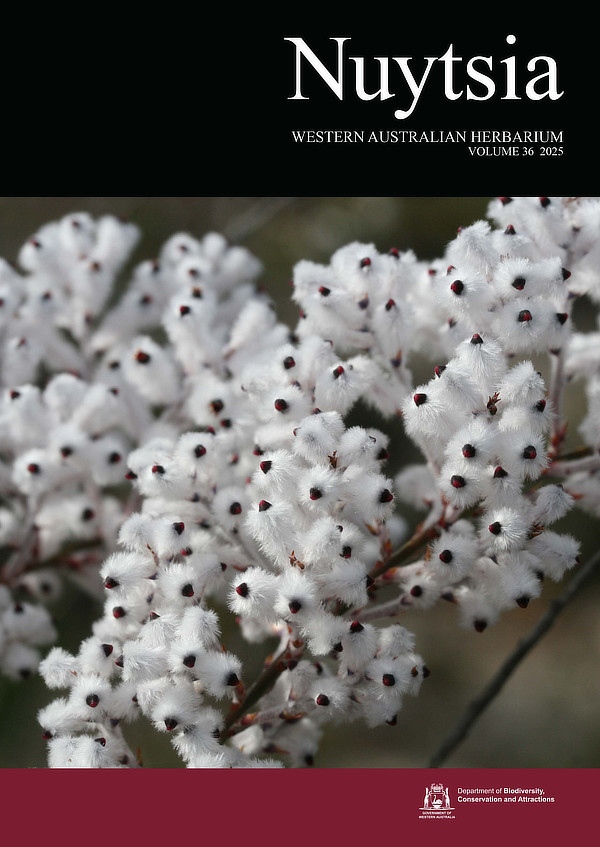
The Western Australian Herbarium’s collections management system, WAHerb, and DBCA’s flora taxonomic names application, WACensus, have been set to read-only mode since 1 October 2025. Recent taxonomic changes are not currently being reflected in Florabase, herbarium collections, or the census. Due to the rapidly approaching holiday season and associated agency and facility soft closures, along with the substantial work involved in data mapping, cleaning, and verification, the migration to the new collection management software is not expected to occur before 1 March 2026, when a further update will be provided. Please reach out to us if you have any questions or concerns.
The notice period
started at 9:45 am on Friday, 12 December 2025 +08:00 and will end at 12:00 pm on Monday, 2 March 2026 +08:00.
The following new species of Cyperaceae from Western Austrralia are described: Cyathochaeta equitans K.L. Wilson (C. clandestina auct.), C. stipoides K.L. Wilson, Eleocharis keigheryi K.L. Wilson, Gahnia sclerioides K.L. Wilson, Schoenus calcatus K.L. Wilson, S. griffinianus K.L. Wilson and S. insolitus K.L. Wilson.
A new subspecies of Lambertia echinata (Proteaceae)
During the field work for a floristic survey of the Swan Coastal Plain (Gibson et al. 1994) a series of areas of unusual plant communities on shallow soils over sheet ironstone were documented. A number of plant taxa found in these areas, including Lambertia echinata R. Br., have been reduced to a single or very few populations with critically low numbers of individuals.
Occurrence and spread of Sea Spurge (Euphorbia paralias) along the west coast of Western Australia
KEIGHERY, G.J. AND DODD, J., Nuytsia11 (2): 285–286 (1997)
Euphorbia paralias along the west coast of Western Australia Euphorbia paralias L. (Sea Spurge) is a herbaceous perennial native to the Atlantic and Mediterranean coasts of Europe, where it is locally abundant on sandy shores, young sand dunes and fine shingle (Blamey & Grey-Wilson 1987). It has become established along the southern coast of mainland Australia from Western Australia to Victoria and north-east Tasmania (Hnatiuk 1990).
The Rhamnaceae of the Kimberley Region of Western Australia
Six native species of Rhamnaceae, all in different genera, are known from the Northern Botanical Province of Western Australia. This province is equivalent to the Kimberley Region as defined in "Flora of the Kimberley Region", in which five of the Rhamnaceae species are described and illustrated (Wheeler 1992). Since publication of the Kimberley flora, a further species and genus, Colubrina asiatica, has been discovered at Koolama Bay in the far north of the Kimberley, and there has been an alteration of the specific name used for the Alphitonia species in the region. In addition, unpublished work on generic boundaries in the Rhamnaceae suggests that the species currently known as Cryptandra intratropica should be placed in a new genus (K. Thiele pers. comm.).
Goodenia katabudjar (Goodeniaceae), a new species from south-west Western Australia
CRANFIELD, R.J. AND SAGE, L.W., Nuytsia11 (3): 297–299 (1997)
A new species of Goodenia (Goodeniaceae) endemic to the Darling District, South West Botanical Province, G. katatbudjar Cranfield & Sage, is described and illustrated. A key to the species considered to be similar to G. katabudjar is provided and the differences between these are briefly noted.
Taxonomic notes on Boronia species of north-western Australia, including a revision of the Boronia lanuginosa group (Boronia section Valvatae : Rutaceae)
The revision of Boronia (Rutaceae) in the Northern Territory, the Kimberley Region of Western Australia, and north-western Queensland is completed, and a key to all species is provided. The B. lanuginosa Endl. species group is characterized as those species with pinnate leaves, a calyx as large as or larger than the corolla, multiangular stellate hairs, and a pronounced ridge on the micropylar side of the seed. This clade comprises the B. lanuginosa species complex, B. filicifolia A. Cunn. ex Benth., B. pauciflora W. Fitzg. and five newly described species: viz. B. decumbens Duretto, B. minutipinna Duretto, B. kalumburuensis Duretto, B. jucunda Duretto and B. tolerans Duretto. The B. lanuginosa species complex has four available names and was analysed numerically using phenetic methods. Two taxa were identified in the analysis. Boronia artemisiifolia var. wilsonii F. Muell. ex Benth. is raised to specific status while B. affinis R. Br. ex Benth. and B. artemisiifolia F. Muell. are synonymized under B. lanuginosa . Additionally, B. rupicola Duretto is described, and B. filicifolia, B. lanceolata F. Muell. , B. lanuginosa and B. pauciflora are lectotypified.
Drosera paradoxa (Droseraceae), a new species from northern Australia
The new species D. paradoxa Lowrie is described and illustrated. It occurs in tropical northern Australia and belongs in Drosera sect. Lasiocephala Planchon.
A taxonomic review of Stylidium subgenus Forsteropsis (Stylidiaceae)
LOWRIE, A. AND KENNEALLY, K.F., Nuytsia11 (3): 353–364 (1997)
Three new species of Stylidium Willd. (Stylidiaceae) from south-west Western Australia, Stylidium leeuwinense, S. marradongense and S. semaphorum Lowrie & Kenneally are described and illustrated. Descriptions and illustrations of S. imbricatum Benth. and S. preissii (Sond.) F. Muell. are provided for comparison and to complete this review of Stylidium subgenus Forsteropsis (Sond.) Mildbr.
A taxonomic revision of the Eucalyptus striaticalyx group (Eucalyptus series Rufispermae : Myrtaceae)
A taxonomic revision of Eucalyptus striaticalyx W. Fitzg. sens. lat. has been undertaken based on morphological characteristics observed through field studies, herbarium research and seedling trials. E. striaticalyx W. Fitzg. subsp. striaticalyx, from the northern goldfields and E. clelandii F. Muell. from the central goldfields of Western Australia are treated and new taxa are described here as E. striaticalyx subsp. delicata Nicolle & P.J. Lang, restricted to a couple of lunette systems in the northern goldfields of Western Australia, E. gypsophila Nicolle, widespread in the Great Victoria Desert of Western Australia and South Australia, with remnant populations extending to the Gascoyne Region of Western Australia, E. repullulans Nicolle from the Pilbara area of Western Australia, and E. canescens Nicolle (with subsp. canescens and subsp. beadellii Nicolle), apparently endemic to the southern Great Victoria Desert of South Australia. Keys, maps and representative illustrations for all the described species are provided.
A synopsis of the annual species of Cyperaceae from central and southern Western Australia
A synopsis, keys and distribution maps are provided for all the annual species of Cyperaceae known from the Eremaean and South West Botanical Provinces of Western Australia. Selected species are illustrated. Some taxa are of conservation significance, including about six species each known from only one collection.
Digitaria aequiglumis (Poaceae), a new weed for Western Australia
LEPSCHI, B.J. AND MACFARLANE, T.D., Nuytsia11 (3): 425–427 (1997)
Digitaria Haller is a cosmopolitan genus represented in Western Australia by 15 indigenous and four introduced species. In early 1996, the first author collected a weedy Digitaria (Lepschi & Lally 2486) on the northern outskirts of Perth which did not match any Digitaria species so far recorded from Western Australia. Subsequent examination of the collection by the second author revealed the plant to be D. aequiglumis (Hackel & Arechav.) Parodi, a South American species sparingly naturalized in eastern and southern Australia (Webster 1984).
A treatment of the genus Crowea (Rutaceae) for Volume 26 of the "Flora of Australia" has been submitted. This paper describes a new subspecies included in that treatment and explains the nomenclatural decision that was taken with regard to the use of one of the varietal names.