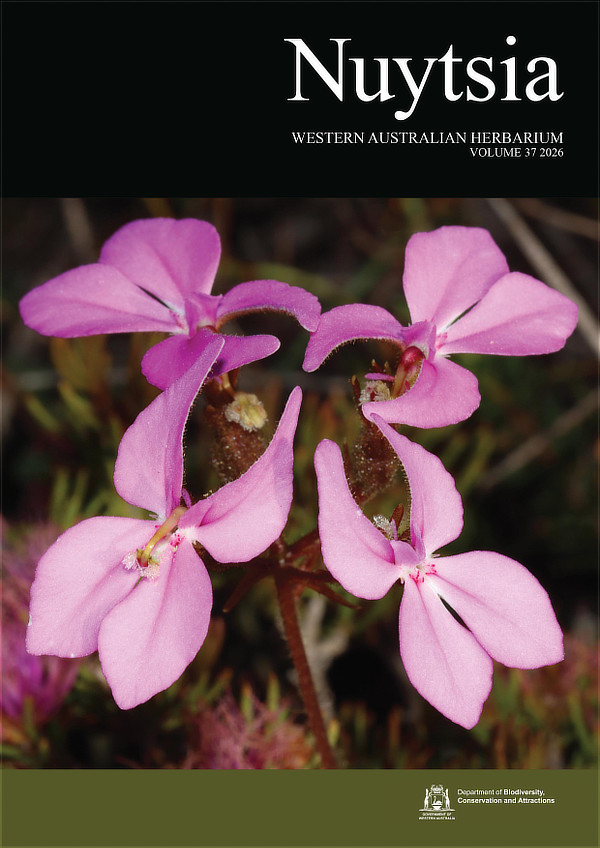
Volume 37
https://doi.org/10.58828/nvol01037
Volume 37 (6 March 2026)
A taxonomic review of the Styphelia blepharolepis group (Ericaceae: Epacridoideae: Styphelieae)
HISLOP, M., Nuytsia 37: 1–16 (2026)
The taxonomy of the small, infrageneric Styphelia blepharolepis group is updated with the addition of two new species, S. cranfieldii Hislop and S. semitrullata Hislop & E.A.Br., and descriptions for the three long-established taxa, S. blepharolepis F.Muell., S. densifolia Hislop, Crayn & Puente-Lel. (until recently, Leucopogon flavescens var. brevifolius Benth.) and S. flavescens (Sond.) F.Muell. A new subspecies, subsp. stirlingensis Hislop, is recognised for S. flavescens. A morphological synopsis of the group is provided along with a key to species.
Nomination of a reference specimen for Amanita xanthocephala (Agaricales: Amanitaceae)
DAVISON, E.M., GIUSTINIANO, D., BOUGHER, N.L. AND BARRETT, M.D., Nuytsia 37: 17–32 (2026)
For Amanita xanthocephala (Berk.) D.A.Reid & R.N.Hilton we designate the specimen PERTH 08944555 from Kings Park as an informal reference specimen to complement the holotype K(M)236388, collected by Drummond from the Swan River Colony in 1843, and provide a description based on Western Australian collections. Sequences from the nuclear ribosomal transcribed spacer (ITS) region from the reference specimen and collections from Victoria and Western Australia cluster together in a well-supported clade. Amanita xanthocephala throughout southern Australia appears to be a single species. Amanita xanthocephala f. mcalpineana (Cleland & Cheel) D.A.Reid has a yellow pileus, however an ITS sequence published on the Atlas of Living Australia does not differ from those with an orange or reddish orange pileus, suggesting it is a common and variable species. Amanita xanthocephala f. mcalpineana is synonymised with A. xanthocephala.
Contributions to Orchidaceae in Western Australia: recognition of five new species
BROCKMAN, G. AND FRENCH, C.J., Nuytsia 37: 33–44 (2026)
Cyanicula micrantha G.Brockman & C.J.French, Paracaleana petraea G.Brockman, Paracaleana semota G.Brockman, Pterostylis inflata G.Brockman & C.J.French and Thelymitra congesta G.Brockman & C.J.French are formally named and described with photographs provided to aid identification. All have been assessed as warranting conservation-listing, with the exception of P. inflata.
A new desert mountain endemic from central Australia: Hysterobaeckea oreophila (Myrtaceae: Chamelaucieae)
ALBRECHT, D.E. AND RYE, B.L., Nuytsia 37: 45–50 (2026)
Taxonomic changes in six Western Australian genera of subtribe Hysterobaeckeinae (Myrtaceae: Chamelaucieae)
RYE, B.L., Nuytsia 37: 51–84 (2026)
Six genera belonging to the subtribe Hysterobaeckeinae Rye & Peter G.Wilson of Myrtaceae tribe Chamelaucieae DC. are updated to allow a more comprehensive coverage of them in the electronic Flora of Australia. The anther morphology of these genera is described, and the distinguishing characteristics of their diaspores are discussed and illustrated. Six poorly known, geographically restricted new species are described for the genera Anticoryne Turcz., Babingtonia Lindl., Scholtzia Schauer and Tetrapora Schauer as A. pallinup Rye, A. vallicola Rye, B. latifolia Rye, S. hortiorum Rye, S. nolba Rye and T. ostentata Rye, and one better known, but still geographically restricted, species is named S. viatica Rye. In Hysterobaeckea (Nied.) Rye, a species that had previously been included under Malleostemon J.W.Green with the phrase name M. sp. Officer Basin (D. Pearson 350) is described as H. uniloculata Rye, expanding the definition of Hysterobaeckea to include a 1-locular ovary, and a second new species is named H. lubrica Rye. One new species of Malleostemon is named as M. sparsus Rye now that additional material is available for it, although it may prove to be a hybrid. Scholtzia umbellifera F.Muell. and S. sp. Folly Hill (M.E. Trudgen 12097) are reduced to synonymy under S. obovata (DC.) Schauer, and the subspecies of S. brevistylis Rye are abandoned. Two phrase-named taxa under Baeckea L. are transferred to the appropriate genera to become Babingtonia sp. Dandaragan (G. Paczkowska s.n. PERTH 08245606) and Tetrapora sp. Youndegin Hill (A.S. George 15772). The new combination Tetrapora leptophylla (Turcz.) Rye is made based on Harmogia leptophylla Turcz., with lectotypifications for both this name and its synonym Baeckea floribunda Benth. Lectotypes are also nominated for Babingtonia camphorosmae (Endl.) Lindl., Scholtzia eatoniana (Ewart & Jean White) C.A.Gardner, S. involucrata (Endl.) Druce and S. laxiflora Benth. New or updated species keys and new descriptions of previously named species or genera are included where appropriate. The ten newly named species occur in the southern half of Western Australia and nine of them have conservation priority, including one that is presumed to be extinct.
Volume 37 (29 October 2026)
Amphipogon indutus (Poaceae), a new conservation-listed species from south-west Western Australia
KARUNAKARAM, M. AND MACFARLANE, T.D., Nuytsia 37: 85–93 (2026)
Amphipogon indutus Karunakar. & T.Macfarlane from south-west Western Australia is described and the morphology and leaf cross-sectional anatomy are illustrated with photographs. The new species is currently known from two localities in the Southern Cross area, one of which is under threat.
New taxa of Caladenia (Orchidaceae) from south-west Western Australia – six new species and four new subspecies
BROCKMAN, G. AND BROWN, A.P., Nuytsia 37: 94–117 (2026)
Six species – Caladenia allochroa G.Brockman & A.P.Br., C. haemantha G.Brockman & A.P.Br., C. lawsonii G.Brockman & A.P.Br., C. primotina G.Brockman & A.P.Br., C. salina G.Brockman & A.P.Br. and C. silvicola G.Brockman & A.P.Br., and four subspecies, C. caesarea (Domin) M.A.Clem. & Hopper subsp. adontia G.Brockman & A.P.Br., C. flava R.Br. subsp. albescens G.Brockman & A.P.Br., C. flava R.Br subsp. secunda G.Brockman & A.P.Br. and C. longicauda Lindl. subsp. nematilis G.Brockman & A.P.Br., are formally described, their relationships with related taxa discussed and the conservation status of rare taxa assessed.
Acacia gibsoniana, a new name for the Western Australian Acacia gibsonii (Fabaceae)
MASLIN, B.R. AND PUSALKAR, P.K., Nuytsia 37: 118–119 (2026)
The red algal genus Callithamniella (Rhodophyta, Ceramiaceae) in Australia, including two new species, C. cygnora and C. carolyniae
HUISMAN, J.M., MCLAY, T.G.B. AND METTI, Y., Nuytsia 37: 120–132 (2026)
Callithamniella Feldm.-Maz. comprises five currently accepted species characterised by a filamentous, uncorticated thallus with prostrate and erect axes, each with at most only a single vegetative lateral branch per cell. The genus is widely distributed but seemingly rarely encountered, and the only known reproductive structures are tetrasporangia, spermatangia and carpogonial branches. Post-fertilization development has not been recorded. Callithamniella flexilis Baardseth is currently the only species of this genus recognised in Australia, recorded from north of Coffs Harbour in New South Wales. The present study was prompted by the collection of an unknown species from the Swan Estuary, Perth, Western Australia, here named as C. cygnora Huisman, McLay & Metti. Additionally, an unnamed taxon from the south coast distinguished by the presence of relatively large vesicular cells, is also confirmed as distinct and named C. carolyniae Huisman, McLay & Metti. DNA sequence analyses of C. cygnora confirm the inclusion of Callithamniella in the Dohrnielleae tribe of the Ceramiaceae, closely related to Antithamnionella Lyle. An updated description for C. flexilis is provided along with a key to the Australian species of the genus.