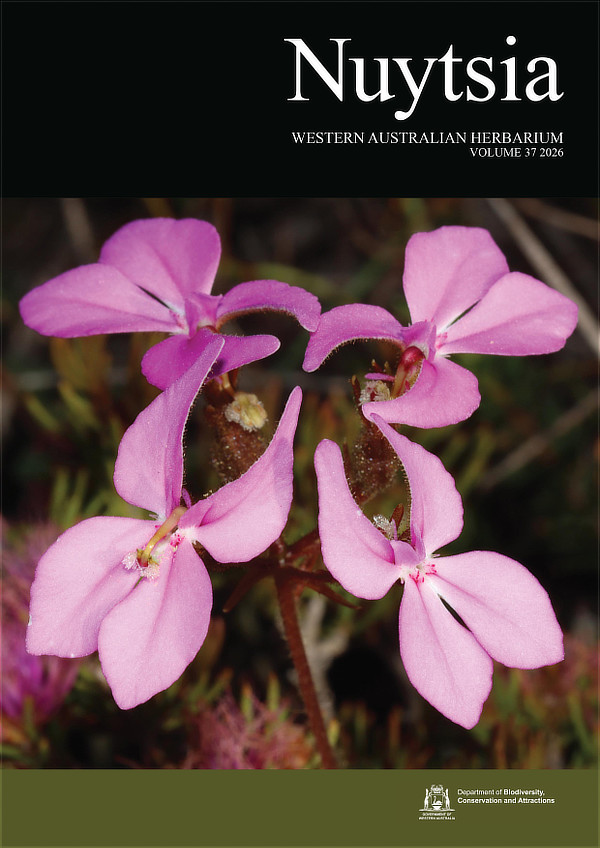
The Western Australian Herbarium’s collections management system, WAHerb, and DBCA’s flora taxonomic names application, WACensus, have been set to read-only mode since 1 October 2025. Recent taxonomic changes are not currently being reflected in Florabase, herbarium collections, or the census. The project team is now conducting testing of the migrated data, and a further update will be provided by the end of the financial year (1 July). Please reach out to us if you have any questions or concerns.
The notice period
started at 9:45 am on Friday, 12 December 2025 +08:00 and will end at 12:00 pm on Wednesday, 1 July 2026 +08:00.
Acacia burrowsiana Maslin, a new species of Acacia Mill. referable to sect. Juliflorae (Benth.) Maiden & Betche is described. It occurs in the south-west arid zone of Western Australia where it is known from only near Mt Magnet and Sandstone. Acacia burrowsiana was listed under its phrase name, Acacia sp. Mt Magnet (T. McKenzie 5), as a Priority One species under the Department of Environment and Conservation’s Conservation Codes for Western Australian Flora.
Acacia cockertoniana (Leguminosae: Mimosoideae), a new species from banded ironstone ranges of the south-west arid zone, Western Australia
Acacia cockertoniana Maslin, a new species with a restricted distribution in the south-west arid zone of Western Australia is described. The species is restricted to banded ironstone ranges which accounts for its discontinuous distribution between Mt Jackson (130 km north of Southern Cross) and near Mt Magnet (c. 270 km north-west of Mt Jackson). Sterile specimens from north of Mt Magnet require confirmation as being this species. Acacia cockertoniana is often abundant in the places where it occurs and current evidence suggests that it is most common in the vicinity of the Windarling Range. Acacia cockertoniana appears to be most closely related to A. balsamea Cowan & Maslin.
Two new species of Acacia (Leguminosae: Mimosoideae) from the Koolanooka Hills in the northern wheatbelt region of south-west Western Australia
MASLIN, B.R. AND BUSCUMB, C., Nuytsia17: 253–262 (2007)
The following two new species of Acacia from the Koolanooka Hills, a low banded ironstone range in the northern wheatbelt region of south-west Western Australia (east of Morawa), are described: Acacia graciliformis Maslin & Buscumb and Acacia muriculata Maslin & Buscumb. Both are listed as Priority One species according to the Department of Environment and Conservation’s Conservation Codes for Western Australia Flora.
Two new Acacia species (Leguminosae: Mimosoideae) from banded ironstone ranges in the Midwest region of south-west Western Australia
MASLIN, B.R. AND BUSCUMB, C., Nuytsia17: 263–272 (2007)
The following two new species of Acacia Mill. from an area of banded ironstone in the Midwest region of south-west Western Australia (between Morawa and Paynes Find) area are described: Acacia karina Maslin & Buscumb and A. woodmaniorum Maslin & Buscumb. Both species are listed as a Priority Two species according to the Department of Environment and Conservation’s Conservation Codes for Western Australian Flora.
Two new Western Australian species of Drummondita (Rutaceae: Boronieae) from banded ironstone ranges of the Yilgarn Craton
MEISSNER, R.A. AND MARKEY, A.S., Nuytsia17: 273–280 (2007)
Two new species of Drummondita Harv. are described, both of which occur on rocky hillsides on the Yilgarn Craton of Western Australia. One of these, D. fulva A.S.Markey & R.A.Meissn., has close affinities to D. microphylla Paul G.Wilson but differs in having a reddish apiculus on the leaf apex, tawny new growth, and sub-orbicular, flattened sepals. The other, D. rubroviridis R.A.Meissn, is closely allied to D. wilsonii F.H.Mollemans, from which it is distinguished by a combination of spreading leaves, solitary, larger red flowers with green petal lobes, and a pointed apical leaf gland. Drummondita fulva is relatively widespread, occurring on both Banded Iron Formation and associated metasedimentary rocks in the Yalgoo region, while D. rubroviridis has a restricted distribution and appears to be endemic to a single banded ironstone range in the Koolanooka Hills. A taxonomic description of these two new species, images and maps of their respective distributions are provided.
A new geographically disjunct and apparently rare subspecies of Eucalyptus jutsonii (Myrtaceae) from Western Australia
NICOLLE, D. AND FRENCH, M.E., Nuytsia17: 281–288 (2007)
The newly discovered subspecies E. jutsonii Maiden subsp. kobela D.Nicolle & M.E.French is described, differing from the typical subspecies in the narrower adult leaves, the generally more slender flower buds with a more pointed operculum and the slightly smaller fruits. The new subspecies is disjunct from the typical subspecies by over 400 kilometres and is known from a single site spanning approximately five kilometres. Eucalyptus jutsonii subsp. kobela may be under threat from mining-related activity and the subspecies meets the criteria for listing as Priority One under the Conservation Codes for Western Australian Flora. A key to E. ser. Micrantherae is included.
A review of the sectional classification of Dicrastylis (Lamiaceae: Chloantheae) and four new arid-zone species from Western Australia
A new delimitation is proposed for three of the sections (Pyramidatae Munir, Spicatae Munir and Verticillatae Munir) of the genus Dicrastylis Drumm. ex Harv. Keys are given to the five sections of the genus and to the 15 Western Australian species of sections Pyramidatae and Spicatae. Four new species from the arid and semi-arid zones of Western Australia are described as Dicrastylis cundeeleensis Rye, D. kumarinensis Rye, D. mitchellii Rye and D. subterminalis Rye. Dicrastylis petermannensis Munir is reduced to a synonym of D. gilesii F.Muell., D. microphyllum Munir to a synonym of D. flexuosa (W.R.Price) C.A.Gardner, and D. georgei Munir is tentatively treated as a synonym of D. cordifolia Munir. None of the previously published subspecies, varieties and forms for any members of the genus is recognised formally here. However, further study of several species complexes occurring in the arid zone is needed as they are extremely variable and taxonomically difficult.
Micromyrtus trudgenii (Myrtaceae: Chamelaucieae), a new species from the Blue Hill Range area of south-western Australia
The new species Micromyrtus trudgenii Rye has conservation priority, being restricted to banded ironstone or dolerite hills in a small area south-east of Yalgoo in Western Australia. It is closely related to M. racemosa Benth., differing in its more elongate leaves with a distinct mucro, its yellow flowers and the almost parallel longitudinal slits on its anthers.
Five new conservation-listed species of Goodenia (Goodeniaceae) from southern Western Australia
SAGE, L.W. AND SHEPHERD, K.A., Nuytsia17: 331–346 (2007)
The following new species of Goodenia are described: G. corralina L.W.Sage & K.A.Sheph, G. granitica L.W.Sage & K.A.Sheph., G. jaurdiensis L.W.Sage & K.A.Sheph., G. salina L.W.Sage & K.A.Sheph. and G. turleyae L.W.Sage & K.A.Sheph. All of these species are apparently geographically restricted and have conservation priority. Distribution maps and images of the holotypes are included and amendments to the “Flora of Australia” Goodenia key are given to accommodate these new species.
Pityrodia iphthima (Lamiaceae), a new species endemic to banded ironstone in Western Australia, with notes on two informally recognised Pityrodia
Pityrodia iphthima K.A.Sheph. is a new species recently discovered on a single banded ironstone outcrop north of Meekatharra. This species is allied to the declared rare P. augustensis Munir, but is morphologically distinct in having discolorous leaves, larger, ovate bracts, longer calyx tube, shorter branched hairs on the outer surface of the calyx and shorter filaments. Distribution and habit images of P. iphthima are provided. In addition, the informal taxon Pityrodia sp. Dalwallinu (M. Hislop 1860) is synonymised with P. bartlingii (Lehm.) Benth.
Three new species of Tecticornia (formerly Halosarcia) (Chenopodiaceae: Salicornioideae) from the Eremaean Botanical Province, Western Australia
Three new samphires that occur on saline floodways and around salt lakes in the semi-arid and arid zones of the Eremaean Botanical Province are described. Tecticornia cymbiformis K.A.Sheph. & Paul G.Wilson, a conservation Priority listed species currently known from three disjunct populations, has been recognised as distinct for a number of years but has never been formally described. A second Priority species, T. mellaria K.A.Sheph., is only found on gypseous dunes in the vicinity of a large gold mine in the eastern Goldfields. Tecticornia laevigata K.A.Sheph., is closely allied to T. mellaria but has a widespread distribution and is not considered to be under threat. Images are included along with distribution maps and an amended “Flora of Australia” key to the former genus Halosarcia Paul G.Wilson.
Tecticornia indefessa (Chenopodiaceae: Salicornioideae), a new mat samphire (formerly Tegicornia) from north of Esperance, Western Australia
A taxon previously thought to be an intergeneric hybrid between an unknown species of the former genus Halosarcia Paul G.Wilson (now Tecticornia Hook.f.) and Tegicornia uniflora Paul G.Wilson (now Tecticornia uniflora (Paul G.Wilson) K.A.Sheph. & Paul G.Wilson) is recognised as a distinct species: Tecticornia indefessa K.A.Sheph. While sharing a similar mat-like habit and perianth structure to the dioecious T. uniflora, this taxon has bisexual or female flowers with distinctive seeds. Previous analysis of nuclear DNA sequences supports this taxon as distinct. Illustrations and maps and a revised description of T. uniflora are included.
Two new Western Australian species of Dodonaea (Sapindaceae) from northern Yilgarn ironstones
SHEPHERD, K.A.,RYE, B.L.,MEISSNER, R.A. AND WEST, J.G., Nuytsia17: 375–384 (2007)
Dodonaea amplisemina K.A.Sheph. & Rye and D. scurra K.A.Sheph. & R.A.Meissn. are two new species that occur on banded ironstone, greenstone or basalt hills in the Yilgarn region of Western Australia and are here described. Both species have conservation priority. A distribution map and photographs of the new species are presented along with amendments to the relevant part of the “Flora of Australia” key to species of Dodonaea.
Kunzea acicularis, K. strigosa and K. similis subsp. mediterranea (Myrtaceae) - new taxa from near Ravensthorpe, Western Australia
TOELKEN, H.R. AND CRAIG, G.F, Nuytsia17: 385–396 (2007)
A re-assessment of additional material in the Kunzea preissiana Schauer and K. similis Toelken complexes resulted in two new species and a subspecies being described: K. acicularis Toelken & G.F.Craig, K. strigosa Toelken & G.F.Craig and K. similis subsp. mediterranea Toelken & G.F.Craig. A revised key to Kunzea Rchb. subsect. Floridae Toelken, a table of characters for critical species in the K. preissiana complex, and detailed discussions are provided.
Lobelia cleistogamoides (Campanulaceae, subfamily Lobelioideae, Lobelia sect. Holopogon), a new species related to L. heterophylla from Western Australia and South Australia
WALSH, N.G. AND ALBRECHT, D.E., Nuytsia17: 397–402 (2007)
Lobelia cleistogamoides N.G.Walsh & Albr., a member of the L. heterophylla Labill. complex, is described. The new species is known to occur from near Mullewa to just east of Esperance in Western Australia, with a disjunct occurrence on the Eyre Peninsula in South Australia. It differs from L. heterophylla s. str. principally in its much smaller flowers and has been known previously as Lobelia sp. small flowers (K.F. Kenneally 7705). Current collection information precludes an accurate assessment of its conservation status.
Allocasuarina hystricosa (Casuarinaceae): a new species from south-west Western Australia, with notes on related species
Allocasuarina hystricosa Wege is described as new. Known largely from the Ravensthorpe region, this dioecious species is characterised by erect branchlets with 10–12 leaf teeth per whorl, long articles (mostly 15–35 mm long), and three (more rarely two or up to five) spines per cone bracteole protuberance. Revised descriptions are provided for the phylogenetically related species A. scleroclada (L.A.S.Johnson) L.A.S.Johnson, A. corniculata (F.Muell.) L.A.S.Johnson, A. spinosissima (C.A.Gardner) L.A.S.Johnson, A. globosa L.A.S.Johnson and A. tortiramula E.M.Benn., and a lectotype chosen for A. tortiramula. A putative new taxon, A. spinosissima subsp. short spine (D.L. Serventy & A.R. Main s.n. 25/8/1960), is highlighted for further research. The recent acquisition by the Western Australian Herbarium of a significant number of Allocasuarina specimens of Western Australian origin is noted.
New species and new circumscriptions in Stylidium (Stylidiaceae)
The following four triggerplants from south-west Western Australia are newly described: Stylidium applanatum Wege, S. bellum Wege, S. diademum Wege and S. rosulatum Wege. Stylidium luteum R.Br. subsp. clavatum Carlquist is raised to species level, S. squamellosum DC. and S. striatum Lindl. are redefined, S. rigidifolium Mildbr. is placed into synonymy under S. striatum, and S. zeicolor F.L.Erickson & J.H.Willis is reinstated. With the exception of S. zeicolor and S. diademum, all of these species have a conservation listing.
Observations on the rare triggerplant Stylidium coroniforme (Stylidiaceae) and the description of two allied taxa of conservation concern
WEGE, J.A. AND COATES, D.J., Nuytsia17: 433–444 (2007)
Stylidium amabile Wege & Coates, a new, rare triggerplant from near Maya in south-west Western Australia, is described and illustrated. This new species has morphological affinity to the rare Wongan Hills triggerplant S. coroniforme F.L.Erickson & J.H.Willis, but has a distinct stigma, a different pattern of corolla markings and is genetically distinct. A revised description of S. coroniforme is provided and S. coroniforme subsp. amblyphyllum Wege, a new infraspecific taxon with distinctive leaves and a distribution near Quairading, is recognised. These three taxa are among the most geographically restricted within the triggerplant genus and all are vulnerable to local extinction.
Two new triggerplants (Stylidium; Stylidiaceae) from the eastern margin of the Swan Coastal Plain, Western Australia
WEGE, J.A.,KEIGHERY, G.J. AND KEIGHERY, B.J., Nuytsia17: 445–452 (2007)
Stylidium ferricola Wege & Keighery and S. korijekup Wege, B.J.Keighery & Keighery are newly described. Stylidium ferricola is endemic to the southern ironstones near Busselton and is distinctive in the genus on account of its compact, rosetted habit, narrowly-oblanceolate leaves with entire margins and a hair-like mucro, paniculate inflorescences, oblong to cylindrical hypanthia bearing glandular trichomes, and vertically-paired corolla lobes. Stylidium korijekup is known from a single population occurring on laterite soils near Harvey and is characterised by a cormaceous habit, petiolate leaves, glabrous scapes bearing scattered sterile bracts, paniculate inflorescences, glabrous hypanthia and calyces, creamy-yellow and laterally-paired corolla lobes, and six, oblong, red-tipped throat appendages. Both species are flagged as being of conservation concern.
A new species of Arabidella (Brassicaceae) from Western Australia
WEGE, J.A. AND LEPSCHI, B.J., Nuytsia17: 453–458 (2007)
Arabidella chrysodema Lepschi & Wege is described as new. Named for its widespread distribution in the Goldfields region of southern Western Australia, this species differs from others in the genus in being an herbaceous annual with pinnatifid leaves and a narrowly elliptic to narrowly oblong siliqua. Photographs and a distribution map are provided along with a key to the species of Arabidella.